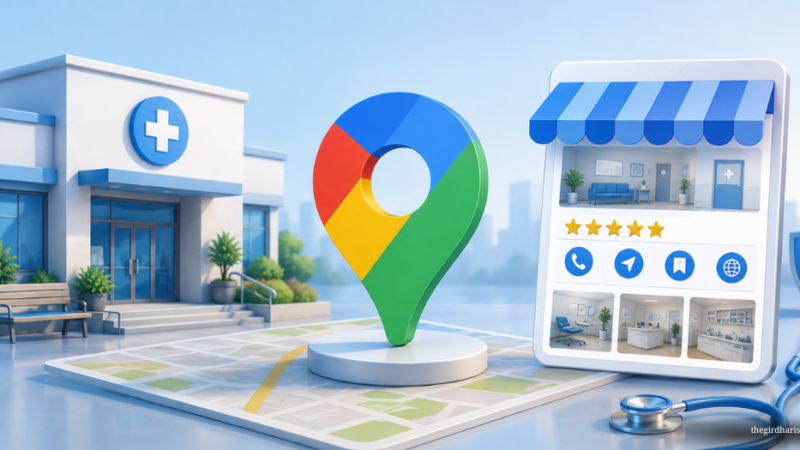
Local SEO for coaching institutes is the work of ranking your Google Business Profile and website for searches like “NEET coaching near me” or “best CA classes in Vaishali Nagar” — the queries a parent runs at the moment they’re choosing between three institutes, not discovering that coaching exists. Facebook and Instagram ads create interest. Google’s local pack closes it. If you’re only running ads, you’re paying to send a parent to a search result where a competitor with 300 reviews wins the admission.
That last sentence is the part most institute owners haven’t priced in.
If my Facebook ads are generating enquiries, what am I actually losing?
You’re losing the enquiries you never see.
Here’s the sequence that plays out every admission season. A parent sees your Instagram ad for a free JEE demo class. They don’t click the form. They open Google and type your institute’s name, or worse, “JEE coaching near me.” Google shows a map with three listings, star ratings, review counts and distance. Your listing is fourth, or has 22 reviews at 3.9 stars, or isn’t there at all.
The parent calls one of the three. You paid for that parent’s attention and a competitor collected the admission. Your ad budget partly subsidised their batch.
This isn’t theoretical. The Birdeye State of Google Business Profiles 2026 report found that 86% of profile impressions come from category-style “near me” searches rather than people searching a business by name. Most people who find you on Google didn’t know your name when they started.
How is local SEO different from the Facebook ads I’m already running?
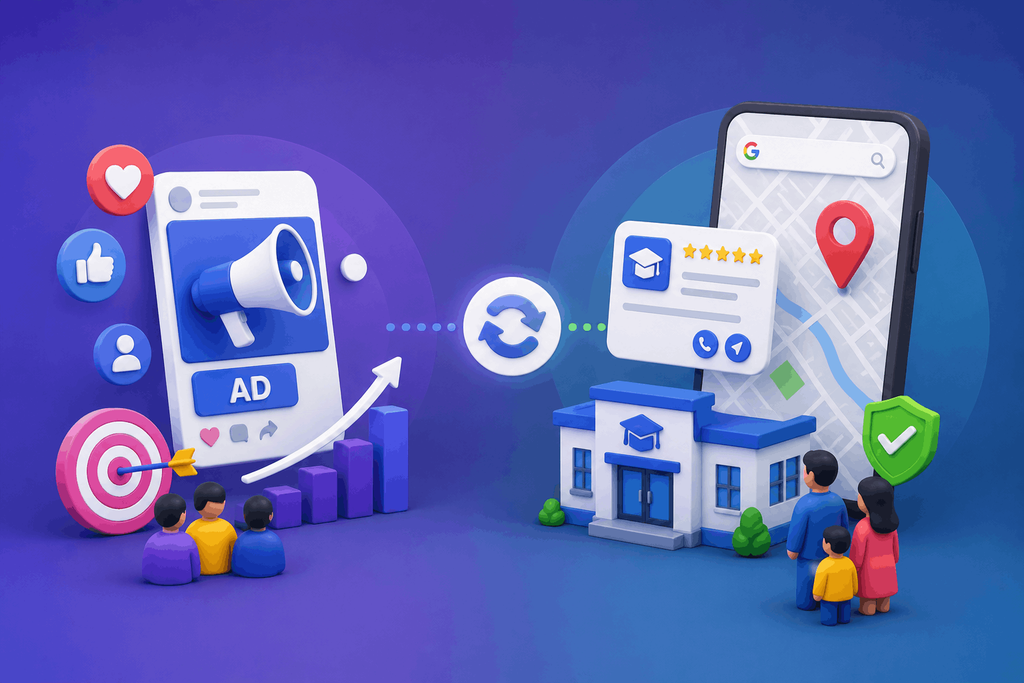
They do different jobs, and you need both.
Facebook and Instagram ads create demand. They interrupt someone who wasn’t looking. Excellent for demo class registrations, result announcements, new batch launches, and reaching parents in a specific pincode. Instant to switch on. Stops dead the day you stop paying.
Local SEO captures demand. It puts you in front of someone who has already decided to enrol and is now comparing options within 5 km. Slow to build, roughly three to six months. Keeps delivering through the next several admission cycles without further spend.
The mistake isn’t running ads. It’s running only ads, which means you’re renting attention forever without ever building the asset that converts it. Ads are your top of funnel. Your Google Business Profile is your shortlist. Right now, for most institutes, the shortlist stage is unmanaged.
What does a parent actually search before choosing a coaching institute?
The queries fall into three tiers, and institutes usually optimise for the wrong one.
Discovery: “NEET coaching near me,” “best IIT coaching in Kota,” “SSC classes Malviya Nagar.” Category searches. These resolve to the local pack, and if you’re not in the top three you’re effectively invisible.
Comparison: “[Institute A] vs [Institute B],” “top 5 CA coaching in Jaipur.” These pull up listicles and forum threads on Careers360, Collegedunia and Reddit — pages you don’t own.
Verification: “[Your institute] fees,” “[Your institute] reviews,” “[Your institute] timings.” This tier is the blind spot. A parent who is already sold on you searches your name to verify, and what surfaces is an unclaimed Justdial page from 2019, a Careers360 thread, and your Google listing showing an old fee structure. You lose people at the verification step and never find out.
Local SEO checklist for coaching institutes
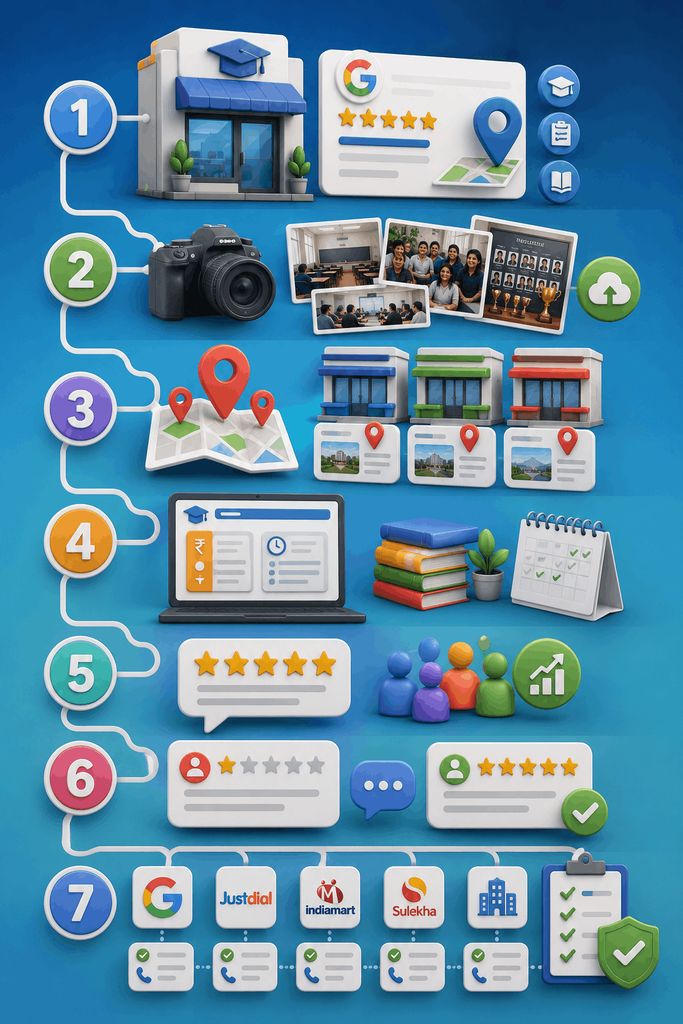
Seven things, in order of impact:
- Claim your Google Business Profile and set the right primary category. “Coaching Center” or “Test Preparation Center,” not “Educational Institution.” Add secondary categories for every exam you prepare students for.
- Add 20+ real photos and keep adding them. Classrooms in session, faculty, the results board, a batch photo. The same Birdeye report found the average verified profile has fewer than one photo — meaning this is a low bar your competitors probably haven’t cleared either.
- Build a separate Google Business Profile and a separate landing page for every branch. Unique content on each: that branch’s faculty, batch timings, directions from a local landmark. Duplicating the same copy across three branch pages makes Google pick one and ignore the other two.
- Publish your fee ranges and batch timings on your website. Institutes hide fees to force a phone call. It backfires: the parent searches “[your institute] fees,” finds nothing on your site, finds a stale number on a directory, and calls someone transparent instead.
- Build reviews continuously, never in bulk. Five to eight a month, all year. Bulk-collecting fifty reviews in one week during admission season is the fastest way to get them filtered — Google treats velocity spikes as manipulation.
- Reply to every review, especially the angry ones. A measured public reply to a one-star review from a student who didn’t clear converts more parents than the review costs you. A defensive reply costs you the batch.
- Fix your NAP everywhere. Your name, address and phone must match exactly across your site, GBP, Justdial, IndiaMART, Sulekha and any old listing. Conflicting details suppress local rankings.
When should a coaching institute start local SEO?
In your off-season, which is precisely when it feels least urgent.
This is the timing trap that keeps institutes stuck on ads. Admissions compress into a few weeks after board and entrance results. Local SEO takes three to six months to compound. So an owner who decides in April that he needs Google rankings for a May admission cycle discovers he’s a season late, panics, and buys more Facebook ads. Next year, same thing.
Reverse the calendar. Build August through November — profile, reviews, branch pages, fee transparency — so the asset is mature when the April to June rush arrives. That’s the entire trick, and it’s the reason this article isn’t about tactics you couldn’t find elsewhere.
What goes wrong in practice
A residential or shared address gets the listing suspended. If you run classes from a rented hall or a coworking desk, verify carefully. A suspended profile removes you from local search completely, usually right before admission season.
Reviews get incentivised. Offering a fee discount for a five-star review violates Google’s policy, and students say so in the review text. It’s visible and it’s recoverable only slowly.
Nobody tracks it. Facebook gives you a cost-per-lead in a dashboard. Google Business Profile Insights sits unopened. At minimum, ask every walk-in “aapko humara number kahaan se mila?” and count how many say Google.
Grow Your Coaching Institute Locally
Get found by more students searching for coaching institutes near you.
Boost Your Local Visibility No obligation. Straight talk only.Frequently Asked Questions
Is local SEO better than Facebook ads for coaching institutes?
Neither replaces the other. Facebook and Instagram ads create demand and produce enquiries within days, but stop the moment you stop paying. Local SEO captures parents who are already comparing institutes and keeps working across admission cycles. Run ads for demo classes and batch launches; use local SEO to win the comparison step.
How long does local SEO take to work for a coaching institute?
Google Business Profile corrections can shift local visibility within two to four weeks. Meaningful local pack rankings for competitive terms typically take three to six months. Start in your off-season so the results land before the admission rush.
Do I need a separate Google listing for each branch?
Yes. Each branch with a distinct staffed address needs its own verified profile and its own landing page with unique content. Sharing one listing across branches means you rank in one locality and are invisible in the others.
How many Google reviews does a coaching institute need?
There’s no threshold, only a relative one: you need more, and better-rated, than the two or three institutes within a few kilometres of you. Look them up today. Build steadily at five to eight a month rather than in bursts.
What’s the fastest thing I can fix this week?
Search your own institute’s name on a phone that isn’t logged into your account. Whatever wrong or missing information you find in the first screen — fee page, hours, an unclaimed directory listing, an unanswered review — fix that first.