
A neglected Google Business Profile costs a clinic patients in one specific way: when someone in your area searches “dentist near me” or “child specialist in [your city]”, Google ranks the three listings it trusts most, and an unverified, miscategorised, or review-thin profile doesn’t make that shortlist. Local SEO for clinics in India comes down to six things that actually move rankings and calls — correct verification, the right primary category, an accurate map pin, real operating hours, a steady flow of recent reviews, and a phone that gets answered. Everything else you’ve been told to do, including weekly GBP posts and keyword-stuffed descriptions, is close to busywork.
Here’s how to set it up properly, in the order that matters.
Is a half-finished Google Business Profile really losing you patients?
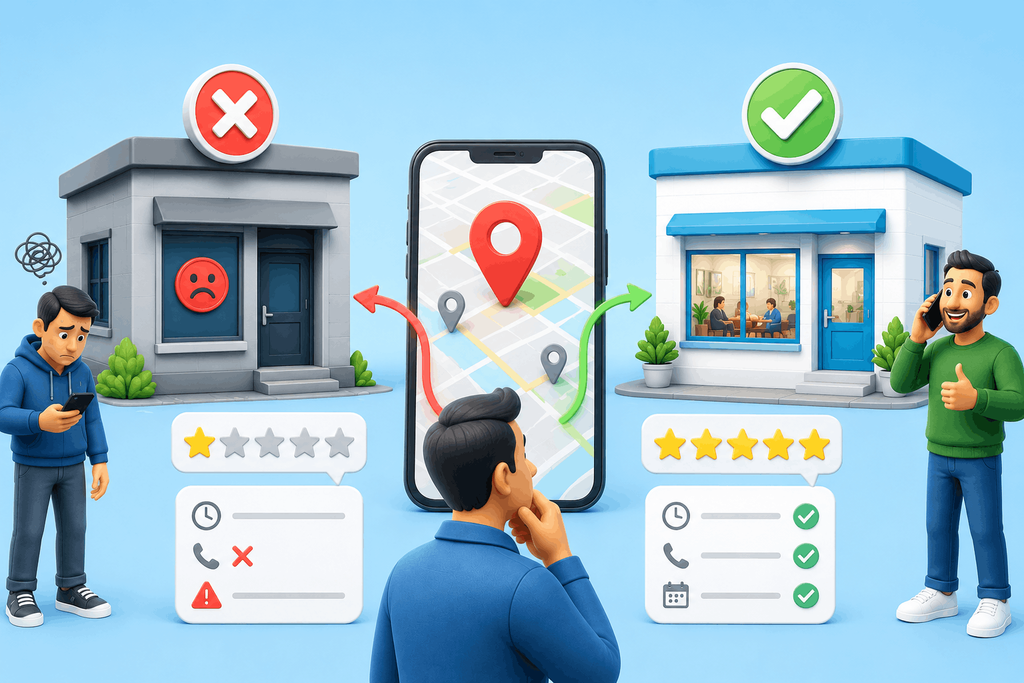
Nobody calls to tell you they couldn’t find your clinic. They search, they see three listings in the map pack, two have 80 reviews and clear timings and yours has 6 reviews and “Hours not confirmed”, and they book one of the other two. You never see the patient who didn’t arrive.
The tell is usually in your own numbers. If patients regularly say “I couldn’t find your place” or “I called but nobody picked up”, your GBP is either misdirecting people or sending calls into a void. Both are fixable in an afternoon.
The other tell is worse. If your listing is suspended or unclaimed, someone else can suggest edits to it — competitors, well-meaning patients, Google’s own automated data. I’ve seen a clinic’s hours changed to “Permanently closed” by a bad edit and nobody noticed for three weeks.
Step-by-step: GBP setup for doctors and clinics
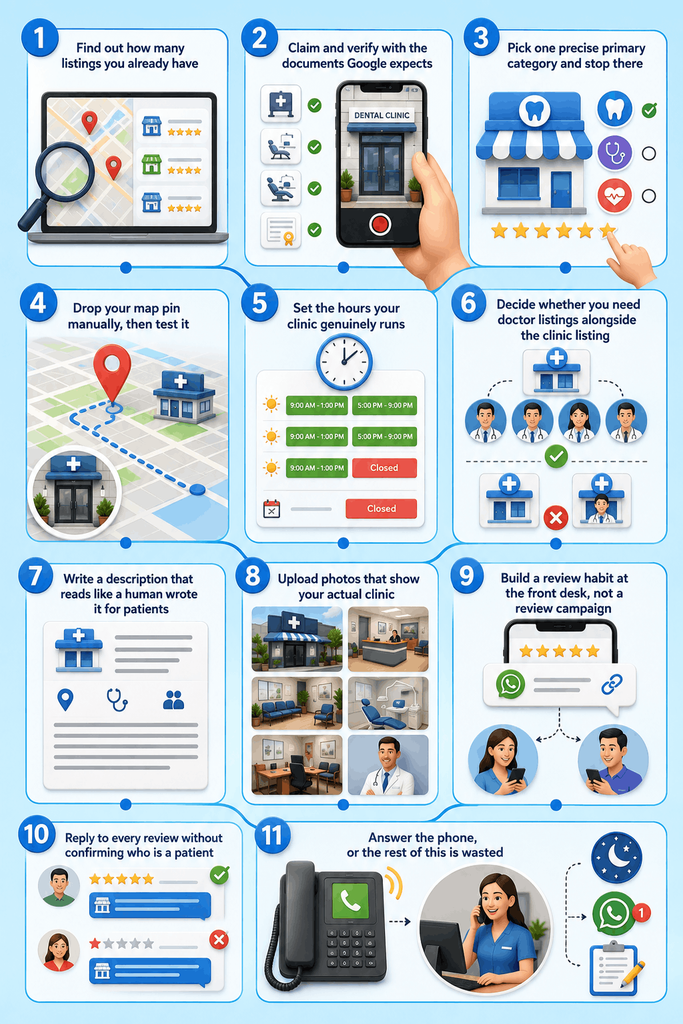
1. Find out how many listings you already have
Before you create anything, search your clinic name, your doctor’s name, and your building name in Google Maps. Clinics that have existed for a few years usually have two or three listings floating around: one you made, one Google auto-generated from a directory, one a former staff member created.
Duplicates split your reviews and confuse rankings. Merge or remove the extras before you optimise anything. Creating a fresh listing on top of existing ones is the most common way clinics dig themselves into a hole.
2. Claim and verify with the documents Google expects
Healthcare categories get extra scrutiny, so plan for video verification rather than a postcard. Have these ready before you start the recording: your clinic signboard visible from outside, the reception area, any equipment that proves the category (a dental chair, an ultrasound machine), and the practitioner’s medical council registration certificate.
Record it in one continuous take, in daylight, walking from the street signboard to the inside. Rejections usually happen because the video never establishes that the address on screen is the address on the listing.
3. Pick one precise primary category and stop there
Your primary category carries more ranking weight than every other field combined. “Dentist” and “Dental clinic” rank differently. “Orthodontist” pulls a different query set than “Dentist”.
Choose the primary category that matches the single treatment you most want to be found for. Add secondary categories for genuine services you offer, not aspirational ones. A general physician who adds “Diabetologist”, “Cardiologist”, and “Physiotherapist” because the clinic occasionally handles those cases ends up ranking clearly for none of them.
4. Drop your map pin manually, then test it
This matters more in tier-2 and tier-3 cities than anywhere else, because address data is thin and Google’s geocoding guesses badly. Your listing address may be correct while the pin sits 400 metres away on a main road.
Open your listing in Maps on a phone, tap Directions, and drive or walk the route it gives. If it takes you to the wrong gate, the wrong lane, or the back of the building, drag the pin to your actual entrance and save. Then add landmark detail in the address line the way patients say it locally.
5. Set the hours your clinic genuinely runs
Indian clinic timings are almost never a simple 9-to-6, and Google supports the split. Enter your morning and evening OPD sessions as separate time blocks so the afternoon break shows as closed instead of showing you open when nobody’s there.
Add special hours for holidays. A patient who drives to your clinic on a festival day because Google said “Open” leaves a one-star review about it, and that review outranks your explanation for the next two years.
6. Decide whether you need doctor listings alongside the clinic listing
This is the part most clinics get wrong in both directions, and it’s specific to healthcare.
Google’s guidelines allow a separate listing for each public-facing practitioner at a multi-doctor practice, in addition to the clinic listing. So a four-doctor polyclinic can legitimately have one listing for the clinic and one for each doctor, which captures patients searching by doctor name.
But if you are a solo practitioner, you get one listing, not two. A dentist running their own single-doctor clinic who creates both “Smile Care Dental” and “Dr. Ankit Verma – Dentist” at the same address is creating a duplicate, and duplicates in healthcare get suspended. When the suspension hits, both listings go dark, reviews vanish from search, and reinstatement takes weeks.
7. Write a description that reads like a human wrote it for patients
Use the 750 characters to say what you treat, who you treat, where you are, and what a first visit involves. Mention your city and specialities once, naturally.
Do not stuff your business name field with keywords. “Dr. Sharma Best Dental Clinic Jaipur Root Canal Braces” is the single fastest route to a suspension, and it looks desperate to the patient reading it.
8. Upload photos that show your actual clinic
Exterior with signboard, reception, waiting area, consultation room, treatment equipment, and the doctor. Real photos taken on a decent phone beat stock images every time, and patients in smaller cities specifically look for signs that a clinic is clean and real.
Skip the stock photo of a smiling model in a white coat. Everyone recognises it, and it makes people wonder what you’re hiding.
9. Build a review habit at the front desk, not a review campaign
Get your GBP short review link, put it in a WhatsApp message template, and have the front desk send it to satisfied patients on the day of their visit. Twenty reviews spread across four months beats forty reviews in one week, which looks manufactured and often gets filtered.
Never offer a discount or freebie for reviews. In healthcare that’s both a Google violation and an ethics problem, and Indian patients mention incentives in the review text often enough that it gets caught.
10. Reply to every review without confirming who is a patient
Here’s the rule almost nobody tells clinics: your public reply must never confirm that the reviewer received treatment, or reference their condition, procedure, or visit date.
Wrong: “Thank you Sunita ji, glad your root canal went well and hope the swelling has settled.” You just published a person’s medical information.
Right: “Thank you for taking the time to share your feedback. If you’d like to discuss anything about your experience, please call the clinic at [number].”
Handle negative reviews the same way. Acknowledge, apologise generically, move it offline. Arguing with a reviewer about clinical facts in public is the single most damaging thing I see clinic owners do online.
11. Answer the phone, or the rest of this is wasted
GBP’s main output for a clinic is phone calls, and calls come in bursts when people are searching, which is usually late evening and Sunday morning. If your reception line rings out during the lunch break or after 7 pm, those patients call the next clinic in the list within about a minute.
Check your call log for missed calls this week. If the number surprises you, fix that before you spend another rupee on marketing. A simple WhatsApp auto-reply or an after-hours enquiry capture will recover more patients than any amount of profile polishing.
What actually moves rankings versus what’s busywork
Sorted by real impact for a clinic:
High impact
- Correct, precise primary category
- Verified listing with no duplicates
- Accurate pin location and hours
- Steady flow of recent reviews with replies
- Calls being answered
Moderate impact
- Real photos, updated a few times a year
- Services and treatments listed individually
- Appointment link that works on mobile
- Consistent name, address, and phone number across directories and your website
Mostly busywork for clinics
- Weekly GBP posts (patients rarely read them; low ranking value)
- Keyword-stuffed descriptions
- Chasing hundreds of low-quality citations
- Q&A sections seeded with your own questions
Spend your first month entirely in the top group. Most clinics I audit have skipped it and gone straight to posting.
Grow Your Clinic Locally
Help more patients find your clinic through local search.
Boost Your Local SEO No obligation. Straight talk only.Your Questions Anwered
How long does it take for a Google Business Profile to start bringing patients?
Verification takes a few days to two weeks. Ranking movement in the map pack usually shows within four to eight weeks of fixing categories, pin, hours, and starting a review flow. Competitive urban categories like dentistry and dermatology take longer than a general physician listing in a smaller city.
Can a doctor have a separate Google listing from the clinic?
Yes, if the practitioner is one of multiple public-facing doctors at the practice. A solo practitioner is only allowed one listing, and creating both a clinic listing and a personal listing at the same address counts as a duplicate, which risks suspension of both.
Why did my clinic’s Google listing get suspended?
The usual causes are keyword stuffing in the business name, duplicate listings for a solo practitioner, an address that can’t be verified as a real staffed location, or a sudden burst of reviews. Reinstatement requires an appeal with proof of the business, and it typically takes one to four weeks.
Do I need a website if I have a Google Business Profile?
For ranking in the map pack, a website helps but isn’t mandatory. For converting the people who find you, it matters a lot, because patients check a site to judge credibility, doctor credentials, and treatment details before calling. A basic three-page site with real doctor bios does the job.
Can patients mention their treatment in reviews?
Patients can write whatever they choose. You cannot repeat it back. Keep your replies generic and never confirm someone was a patient, regardless of what their review says.