
The biggest leak in most bank loan journeys is not the landing page. It is KYC and document upload, the step where an applicant who has already committed is asked for files, OTPs and camera access they may not have to hand. Loan application conversion optimization starts by measuring that step, not by redesigning the page above it.
This matters most for a large bank. You have already paid for the traffic, from search, aggregators, DSAs or branch referrals. An applicant who leaves at KYC has told you the product, the amount and usually their PAN and mobile number: your most expensive loss, and your most recoverable.
The step also belongs to nobody in marketing. It sits between digital, operations, risk and a KYC vendor, so quarterly plans default to what digital controls: the landing page.
Leadership sees applications started and loans disbursed. The gap gets labelled “credit rejection”, and nobody questions it.
Where do loan applications actually drop off?

The costly drop-off happens where effort spikes and control leaves the applicant: KYC and document upload. The landing page loses more people in raw numbers, but it loses the least committed ones.
Three mechanisms drive KYC drop-off in any digital loan journey.
Intent is highest when the loss happens. A visitor who bounces from a rate page was comparing. An applicant who leaves at KYC chose you and then got stuck.
Effort jumps without warning. The first screens ask for things the applicant knows: name, income, city. KYC asks for things they must fetch: an Aadhaar-linked mobile that may be a parent’s phone, salary slips in an email, a password-protected bank statement. Every trip to another app can end the journey.
Control passes to someone else. DigiLocker redirects, OTPs, video KYC scheduling and vendor SDKs each hand the applicant to a system outside your page, where they can get lost and your analytics may not follow. When something fails, the message is usually “Upload failed”, with no reason.
In Tier 2 and Tier 3 cities, add older Android phones, patchy data and instructions written only in English.
Some of my peers will argue with this: until the KYC step is instrumented, another landing page redesign is the lowest-return project on a bank’s digital roadmap.
What framework should a bank use to find where applicants are lost?
Use Get Found → Build Trust → Convert, and split Convert at every point where ownership changes hands. Most enterprises get the Convert stage wrong, specifically KYC and documents, because no single team measures it end to end.
| Stage | Question it answers | Owner | Metric |
|---|---|---|---|
| Get Found | Can the right applicants find us for the loan they want? | Marketing, SEO and media agencies | Qualified sessions on loan pages, by product |
| Build Trust | Do they believe the rate, eligibility and terms enough to start? | Product, content and compliance | Eligibility-check starts per qualified session |
| Convert: application start | Can they give basic details without friction? | Digital journeys team | Form start-to-submit rate |
| Convert: KYC and documents | Can they prove who they are and what they earn, on the device they have? | Operations, risk and the KYC vendor, usually with no single owner | Upload attempts to verified documents, retries per document, time in step |
| Convert: offer, KFS and e-sign | Do they accept the terms once they see them in full? | Credit, legal and digital | KFS viewed to e-signed |
The final row carries a regulatory duty. RBI’s Key Facts Statement circular of 15 April 2024 requires banks to give a KFS to prospective borrowers “before executing the loan contract” for all new retail and MSME term loans sanctioned from 1 October 2024. If terms surprise people here, the fix belongs back in Build Trust, not on the e-sign screen.
How do you fix KYC and document upload without breaking compliance?
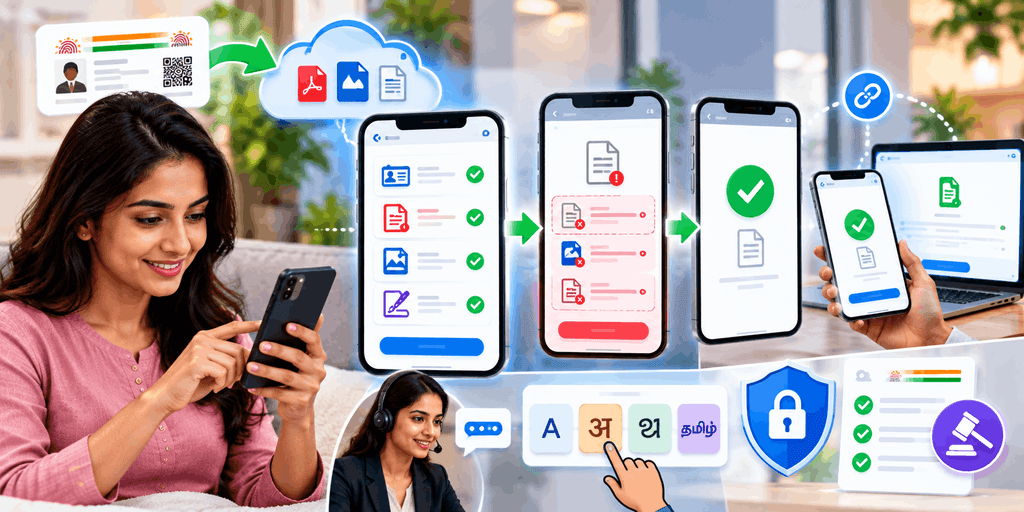
Reduce what the applicant has to fetch, tell them exactly what failed, and let them resume without starting again. Every change sits inside RBI’s KYC and digital lending rules and the DPDP Act, so compliance belongs in the first sprint.
- Pull before you ask for uploads. RBI’s KYC FAQs (updated 9 June 2025) describe non-face-to-face routes including Aadhaar OTP-based e-KYC, V-CIP, and digital channels “such as CKYCR, DigiLocker, equivalent e-document”. Where your policy allows a pull, an upload is avoidable effort.
- Show a checklist before the step. Which documents, which formats, and whether password-protected statements are accepted.
- Write specific error messages. “File above 5 MB”, “photo is blurred” or “PDF needs its password” each lead to a different fix. “Upload failed” leads to an exit.
- Let them resume on another device. An SMS or WhatsApp link, sent with consent, should return them to the exact step. A callback or an AI chatbot for lead capture that hands stuck applicants to a person also helps.
- Translate the KYC screen first. Hindi and regional-language instructions do the most work at the hardest step.
- Ask for permissions only when you need them. RBI’s Digital Lending Directions, 2025 (8 May 2025) require data collection to be “need-based and with prior and explicit consent of the borrower having audit trail”. One-time camera, microphone or location access is allowed with explicit consent, only for onboarding or KYC. The DPDP Rules, 2025 (notified 14 November 2025, with an 18-month phased compliance period) require a separate consent notice that is “clear and easy to understand” and explains the specific purpose.
This is not legal advice. It describes what the rules say; your compliance team decides whether an implementation meets them.
These fixes are the lending-specific end of conversion rate optimisation. The test ideas are cheap. The approvals are not.
What goes wrong when large banks try to fix loan application drop-off?
Approval queues favour the wrong pages. A KYC screen copy change goes through compliance, legal and IT security; a landing page test ships faster, so it wins. Pre-approve a library of error messages once, then test within it.
Central and local teams count different things. Central digital owns the web journey, while branches and DSAs finish applications in assisted mode and chase leads on WhatsApp. Applicants recovered offline vanish from digital metrics or get counted twice.
Agency incentives stop at “application started”. Media agencies optimise to starts, CRO agencies to submits, and nobody to verified documents, so bidding systems learn to buy starters. Send a deeper conversion, such as KYC completed, back to the ad platforms.
Vendor tools are black boxes. Many KYC SDKs and iframes send no events into your analytics, so write step-level events into the vendor contract.
Nobody agrees on the denominator. Analytics says “submitted”, the loan origination system says “login”, credit says “sanctioned”. Google Analytics adds its own rule: in a closed funnel, “users must enter the funnel in the first step”. Agree on one application ID and one set of step definitions before comparing anything.
When doesn’t this apply?
The KYC-first argument is weaker in four situations.
- Qualified traffic isn’t starting. If people who fit the product leave before the eligibility check, you have a Build Trust problem: rate clarity, eligibility, fees.
- Pre-approved offers to existing customers. KYC is already done, so the leak moves to the offer and KFS stage.
- Traffic is low-intent. If aggregator arbitrage or broad display drives the sessions, fix Get Found first. That includes SEO (see why bank product pages lose to aggregators) and AEO/GEO (Answer Engine and Generative Engine Optimisation: being cited in AI Overviews and AI assistants), covered on my AEO/GEO services page and in how banks get cited in AI answers.
- Branch-led products. Many gold loans and small MSME loans in Tier 3 towns collect documents in person. There, branch-level local SEO for banks matters more than the online form.
There is also a real trade-off: some KYC friction does a fraud-prevention job. Remove friction that serves no risk purpose, never the identity checks themselves.
Want More Loan Applications?
Optimize your loan journey and turn more visitors into applicants.
Contact us today. No obligation. 👉 Talk to Our SEO ExpertsWhat do Heads of Digital Journeys ask about loan application conversion?
What is a good loan application conversion rate for an Indian bank?
There is no reliable public benchmark worth quoting, and rates vary by product, channel and device. Measure step-to-step conversion against your own baseline, split by product and by mobile versus desktop. The useful question isn’t whether you beat an industry figure, but which step lost the most committed applicants last month.
Should we redesign the loan landing page first?
Only if the KYC and document step is already measured and healthy. A landing page loses more visitors, but they are the least committed ones. Applicants lost at document upload have already chosen your bank, so each one recovered is worth more. Instrument the later steps first.
Do DigiLocker and V-CIP reduce drop-off?
RBI’s KYC FAQs list DigiLocker, CKYCR and V-CIP among permitted non-face-to-face routes, so banks can use them where their policy allows. Whether they reduce drop-off depends on execution: a DigiLocker redirect that loses session state, or a video KYC slot days away, can add exits. Test each route against your current flow.
How does the DPDP Act affect a loan application journey?
The DPDP Rules, 2025, notified on 14 November 2025, give organisations an 18-month phased compliance period. They require a separate consent notice that is clear and explains the specific purpose of collecting data. That shapes how loan journey consent screens are written. Your compliance team decides whether a given design meets the rules.
How do we measure drop-off when KYC runs inside a vendor tool?
Ask the vendor for step-level events or webhooks keyed to your application ID, and join them to your analytics and loan origination data. If the contract doesn’t provide them, add it at renewal. Until then, a daily export of applications stuck at each KYC status gives you a workable view.
Where should you start this week?
Ask your KYC vendor and loan origination team for one export: every application that entered the document step in the last 30 days, with its last status and error code. Put it beside your analytics funnel for the same period. The gap is your first real number for where applicants are lost.
If you want a second pair of eyes on where your loan journey loses applicants after the landing page, get in touch and ask for a funnel drop-off audit.
