Local SEO in India is the work of getting your business shown, and chosen, when someone nearby searches Google, Google Maps or an AI assistant for what you sell. Google ranks local results on relevance, distance and prominence. In India, four things shape the rest: aggregator listings, WhatsApp, festival hours and transliterated business names.
I’ve done local SEO for Indian businesses for over ten years. Almost every ranking guide a client forwards me was written for a dentist in Ohio.
Those guides assume you created your own listings, your customers call, your holidays sit on fixed dates, and your name has one spelling. None of that holds in Jaipur, Indore or Coimbatore.
This page is the hub. It gives you the shape of the whole job, then sends you to the detailed guide for each piece.
How is local SEO in India different from the US playbook?
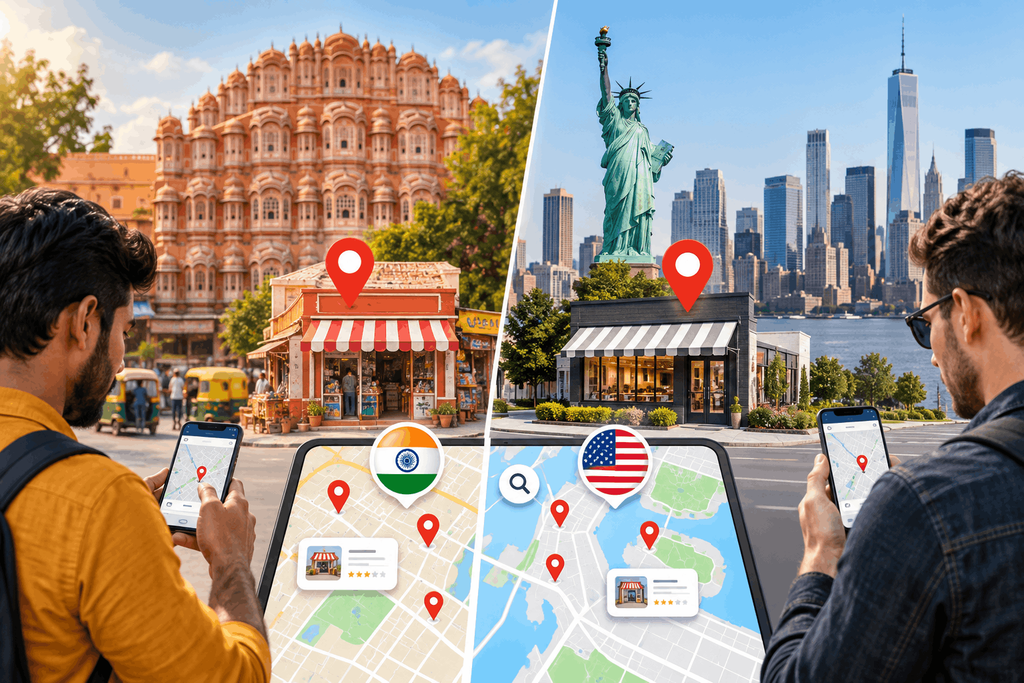
The ranking mechanics are the same. Google Business Profile Help says local results are based mainly on relevance, distance and prominence. Prominence is partly based on how many websites link to you and how many reviews you have. Google also says there’s no way to pay for a better local ranking.
What changes is the ground those factors sit on.
| What US guides assume | What’s true for most Indian local businesses | What it changes |
| You create your own listings | Justdial, Sulekha, IndiaMART or Practo may already list you, with details you didn’t write | Cleanup comes before any new listings |
| Customers call or fill a form | Many first enquiries arrive on WhatsApp | Your contact button and tracking need rebuilding |
| Holidays fall on fixed dates | Festival dates move every year and differ by state | Special hours need a yearly calendar |
| A business name has one spelling | Shree, Shri and Sri can all be the same shop | One spelling has to be locked everywhere |
Here’s the claim plenty of agencies will argue with. For most single-location Indian businesses, I no longer sell citation building. In my experience, cleaning up the aggregator listings that already exist does more good than adding forty new directories nobody in your city visits.
Why do Justdial, Sulekha, IndiaMART and Practo listings you never created matter?
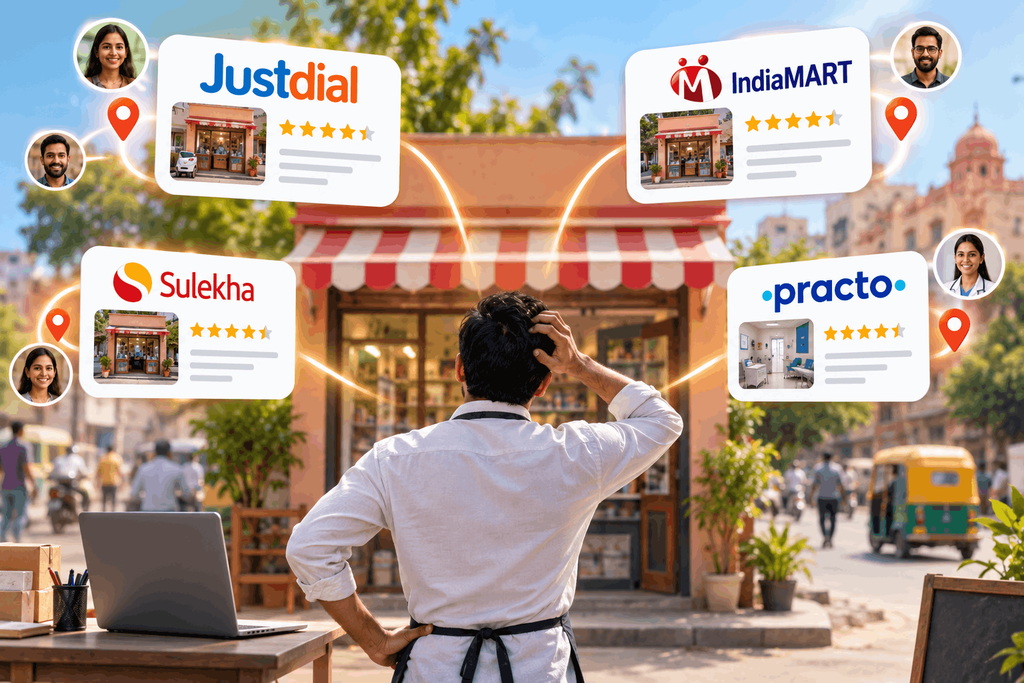
Because they’re already describing your business to customers, to Google and to AI assistants, whether or not you’ve ever looked at them.
On almost every audit I run, I find at least one listing the owner didn’t set up. A user added it, a platform sales rep created it, or it’s left over from an old address. It usually carries an old phone number or a spelling nobody at the business uses.
Google doesn’t publish a “consistency” ranking factor, so I won’t pretend one exists. My reasons are practical. A customer who finds the wrong number never reaches you. An AI assistant summarising local options can repeat the wrong detail, which is where answer engine optimisation starts mattering locally. And three versions of your details make it harder for any system to tell they’re one business.
Which aggregators matter depends on what you do:
- Practo: clinics, doctors, dentists, diagnostic centres
- IndiaMART: manufacturers, traders, wholesalers, B2B suppliers
- Justdial: almost every consumer-facing category, from repairs to coaching
- Sulekha: home services, tutors, event and wedding services
The audit I run, in order:
- Search each platform for your business name, current phone number and any old phone numbers.
- Claim the listings you can. Where you can’t, use the platform’s own correction process.
- Match name spelling, address format, phone and hours to your Google Business Profile exactly.
- Check where enquiries go. Some platforms send leads through their own system, so confirm they reach a number someone answers.
- Get duplicates at old addresses marked closed or removed.
One trade-off: claiming a listing often triggers a sales call for the platform’s paid plan. In my experience, you rarely need that plan just to make the free listing accurate.
Should WhatsApp or the call button be your main conversion point?
For most Indian local businesses, WhatsApp. In my experience, customers here often message before they call, to check a price, timings or whether you cover their area. A profile that only offers a call button loses everyone who isn’t ready to talk yet.
Google lets verified profiles add a WhatsApp click-to-chat link under Edit profile → Contact → Chat, according to Google Business Profile Help. The same page says chat is available only in select regions, so confirm the option shows on your profile before you plan around it.
Here’s the second claim competitors will push back on. For many local businesses, map rank is the wrong number to report. I’d rather track WhatsApp conversations started and bookings closed — which makes this a conversion question as much as a ranking one. Google’s performance report counts calls, direction requests, website clicks and message conversations, but it can’t see whether a chat became a paying customer.
How I set it up:
- Put your WhatsApp Business number on the profile in international format: https://wa.me/91XXXXXXXXXX.
- On your website, use a link with pre-filled text such as “Hi, I found you on your website”, so the first message tells you the source.
- Keep a simple sheet: date, source, enquiry, converted yes or no.
When it doesn’t fit: if nobody can reply during working hours, don’t lead with WhatsApp. An unanswered chat does more damage than no chat button. If enquiries arrive at 11pm, the fix is a rostered reply window or AI chatbot lead capture on WhatsApp, not a bigger chat button. Emergency services, such as a burst pipe or a lockout, should still lead with a call.
This WhatsApp-first setup is the part of my local SEO service that clients most often underestimate.
How do festival hours affect your Google Maps listing?
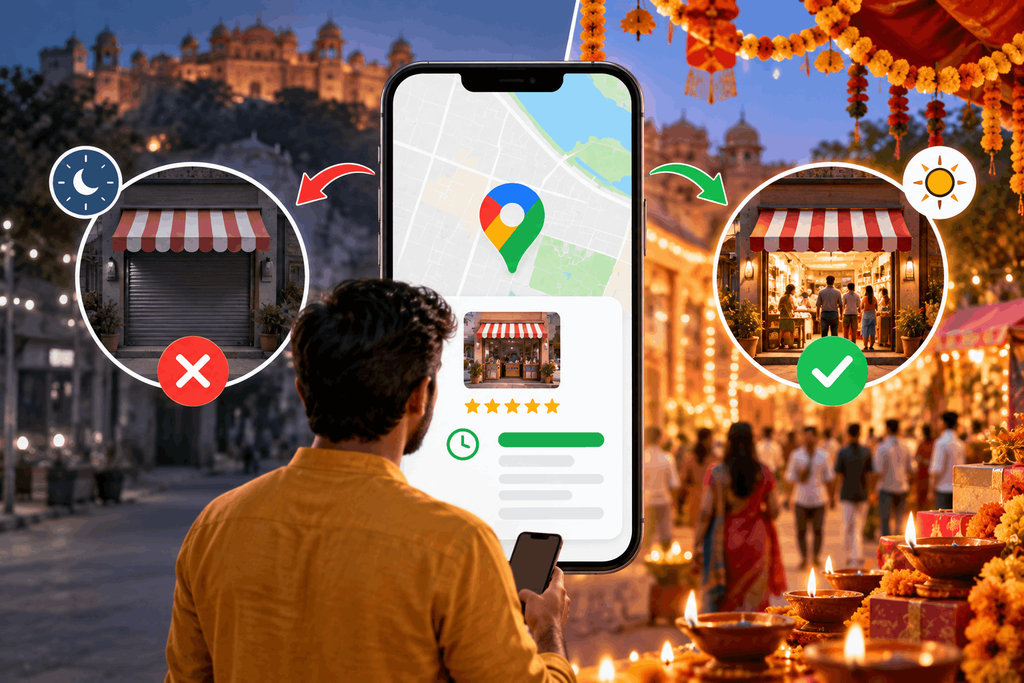
They decide whether a customer who trusted your profile arrives at a closed shutter, and then writes the review.
Google’s business guidelines let you set special hours for particular days, such as holidays. Google’s holidays page says that on listed holidays, a warning may appear on your profile telling users your hours might differ. India’s list on that page includes state-specific holidays as well as national ones.
Google’s ranking help page lists hours, including special hours, as part of a complete profile. I won’t claim festival hours move your Google Map ranking in India by themselves. I set them because a wrong-hours visit is one of the most avoidable sources of one-star reviews I see.
What I do each January:
- Build the year’s calendar. Diwali, Holi, Eid and Navratri move every year, so last year’s dates are wrong.
- Add your state’s festivals. Pongal, Onam, Durga Puja, Gangaur or Bihu matter locally, not only national holidays.
- Plan longer hours too. A jeweller on Dhanteras or a sweet shop before Diwali is usually open later, not closed.
- Update everything together. Google profile, aggregator listings and WhatsApp away message, same week.
How should a transliterated business name appear on Google?
Pick one English spelling, the one on your signboard and website, and use it on every listing, invoice and profile.
Indian names get written in English several ways: Shree, Shri or Sri; Agarwal or Aggarwal; Laxmi or Lakshmi. In my audits, the trouble rarely comes from how customers spell it. It comes from the business itself appearing under three spellings across Google and aggregators.
Google’s guidelines say your name should reflect your real-world name, as used consistently on your storefront, website and stationery. They also say you shouldn’t repeat the name in multiple scripts or languages, even if your signboard shows it that way. So “श्री गणेश स्वीट्स Shree Ganesh Sweets” in the name field breaks the rule.
Don’t add keywords or a city either. The same guidelines say unnecessary information in the name can get your profile suspended. I know a competitor named “Best RO Service Jaipur” may be sitting above you. That profile is one user edit or report away from losing its name, and a suspended profile ranks nowhere.
What order should local SEO in India be done in?
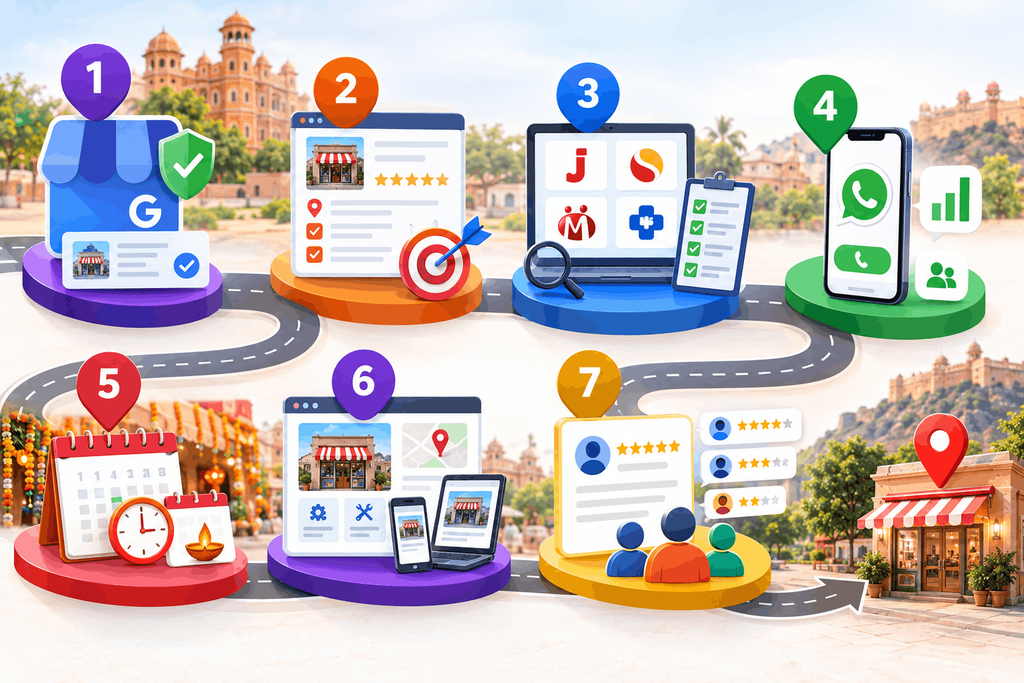
This is the sequence I use. The order matters because the early steps change what the later ones are worth.
- Compliance. Claim and verify your Google Business Profile. Set the real-world name with no keywords, and use an address you can prove.
- Relevance. Choose the most specific primary category, then add services and a plain description. My checklist covers which Google Business Profile fields move rankings and which move calls.
- Aggregator cleanup. Audit the platforms that fit your category and match every detail.
- Conversion. WhatsApp on the profile and website, with source tracking.
- Hours. Regular hours plus the next twelve months of festival hours.
- Website. One page per service you offer locally, with name, address and phone matching the profile. This is where it becomes ordinary SEO.
- Reviews. Ask every customer, not only the happy ones. Google’s fake engagement policy bans paid reviews and selectively asking for positive ones. A repeatable review and reputation management process beats a one-off push every time.
Steps one to five cost nothing but time. If you have a free weekend, do them yourself before you pay anyone. If you’d rather hand over the whole sequence, my local SEO services in India cover local search optimization in India end to end, including the four issues above.
When is local SEO not worth paying for?
I’d rather tell you now than after a three-month retainer.
- You have no verifiable location or service area. Google Business Profile needs a real address or an honest service area. Trying without one risks a suspension.
- Your customers don’t search locally. Most SaaS companies and national online sellers get more from other channels.
- Nobody answers enquiries. More visibility just means more unanswered WhatsApps. Fix the reply process first — roster or automated lead capture — before spending on visibility.
- You need results in 30 days. In my experience, profile fixes show within weeks, but review-driven gains take months.
- The service itself is the problem. Local SEO gets you shown. Reviews decide whether you’re chosen, and those are earned offline.
Want More Local Customers in India? /h3>
Improve your local visibility and attract more customers with the right Local SEO strategy
Get in touch today. No obligation. Straight talk only.What do business owners ask about local SEO in India?
How long does local SEO take to work in India?
In my experience, fixes to categories, name, hours and WhatsApp can change visibility and enquiries within a few weeks. Gains that depend on reviews and links build over roughly three to six months, depending on how crowded your category and locality are. A promise of top map rankings in thirty days usually means searches for your own business name.
Does a Justdial listing help my Google Maps ranking?
Google doesn’t name Justdial or directory consistency as a ranking factor. Its help page names relevance, distance and prominence, with prominence partly based on links and reviews. I fix Justdial listings for a practical reason: customers and AI assistants read them, and those details decide whether you get cited by ChatGPT and Perplexity in your city. A wrong phone number or spelling costs you enquiries whether or not it affects rank.
Can I add WhatsApp to my Google Business Profile?
Yes, if the option is available for your profile. Google Business Profile Help says verified businesses can add a WhatsApp click-to-chat link under Edit profile, then Contact, then Chat. Google also says chat is offered only in select regions. Use your number in international format, and make sure someone can reply during your listed hours.
Can I write my business name in both Hindi and English on Google?
No. Google’s guidelines say you shouldn’t repeat your business name in multiple scripts or languages, even if your signboard shows both. Use the single spelling that matches your storefront, website and stationery. Keep that same spelling on Justdial, IndiaMART, Practo or Sulekha, so every listing clearly points to one business.
Can I pay for Google reviews in India?
No. Google’s fake engagement policy bans reviews paid for in cash or in kind, and bans asking only happy customers. India’s Bureau of Indian Standards published IS 19000:2022 on online reviews for platforms, and the Department of Consumer Affairs consulted in 2024 on making it mandatory. I’m not a lawyer, so check current rules before any review campaign.
Where should you start?
Open an incognito window. Search your business name on Google, on Justdial, and on the one platform that fits your category: Practo, IndiaMART or Sulekha.
Write down every listing where the spelling, phone number or hours differ from your Google profile. That list is your first week of local SEO, and it took ten minutes to build. If you’d like me to go through that list with you and say what’s worth fixing first, get in touch — it’s usually where my consulting work starts.