Build three locality pages, not thirty. A locality page only earns its place if it carries something true about that area that you could not paste onto any other page: named landmarks you actually work near, real travel time from your base, local price differences, and jobs you have finished there. Without those four, you have built a doorway page.
I wrote this because I kept leaving it out. Every time I hand an MSME a local SEO plan for small businesses in India, this question comes up, and every time I answer it on a call.
Why do most locality pages get ignored by Google?
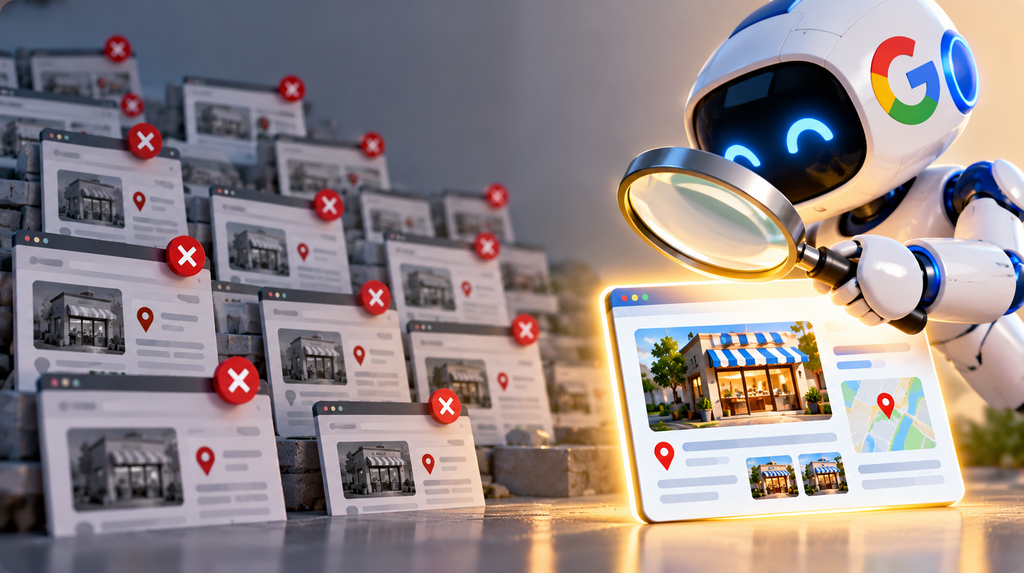
Because they are the same page with the city name swapped, and Google has a name for that.
Google’s spam policies define doorway abuse as “when sites or pages are created to rank for specific, similar search queries,” and the first example listed is “having multiple domain names or pages targeted at specific regions or cities that funnel users to one page” (Google Search Central, spam policies, updated 28 August 2026).
That describes exactly what most agencies build. Twenty pages, one paragraph each, city name find-and-replaced, all funnelling to one contact form.
The same document covers scaled content abuse: “when many pages are generated for the primary purpose of manipulating search rankings and not helping users.” Thirty area pages from a template and an AI prompt sit inside both definitions.
The mechanism matters more than the rule. Google sees near-duplicate pages and picks one, or none. Your twenty pages compete with each other for the same query.
- Explore Now:- The Local SEO Audit Checklist
What actually has to differ between one locality page and another?
Four things. If a page has fewer than three of them, I do not publish it.
- Named landmarks you genuinely operate near. Not “near the city centre.” The specific market, hospital or sector number. In Jaipur that means writing Malviya Nagar, Vaishali Nagar or Mansarovar and then naming what sits inside them.
- Real travel time from your base. “We reach Vaishali Nagar in about 25 minutes from Civil Lines” is a fact a competitor cannot copy honestly, because their base is somewhere else.
- Local price or scope differences. A higher call-out charge for outer areas. A different minimum order. Access constraints that change the job. If your pricing is flat everywhere, say that — it is still a fact.
- Named jobs you have completed there. Society, building and project names, with permission. The hardest one to fake and the strongest one to have.
Google’s guidance on creating helpful content asks whether your page shows “first-hand expertise and a depth of knowledge (for example, expertise that comes from having actually used a product or service, or visiting a place)” (Google Search Central, updated 10 December 2025). Visiting a place. That line is written for this page type.
How many locality pages should an MSME actually build?
The common advice is to cover every area you serve, because more pages catch more long-tail queries. In my experience that is backwards for a business under roughly fifteen staff. You do not have the field data to fill twenty pages honestly, and a page you cannot fill honestly dilutes the three you could.
Pick the three areas where you already do the most work. Not the three with the highest search volume — the three where you have the most invoices, photos and names.
Once those three rank and convert, you have a template built from real material. Then add the fourth. This is slower, and it is the reason I keep losing that argument in sales calls.
The trade-off, stated plainly: three pages will not cover your full service area, and you will miss searches in the areas you skipped. I think that beats twenty pages Google treats as doorway abuse. If you have genuine operational depth in fifteen areas, you should disagree with me.
Multiple physical branches is a different problem — how multi-location businesses handle local SEO in India covers it, and the rules are not the same.
- Explore Now:- Local SEO for Dentists in India
Where do I find genuinely local detail if I have never written this before?
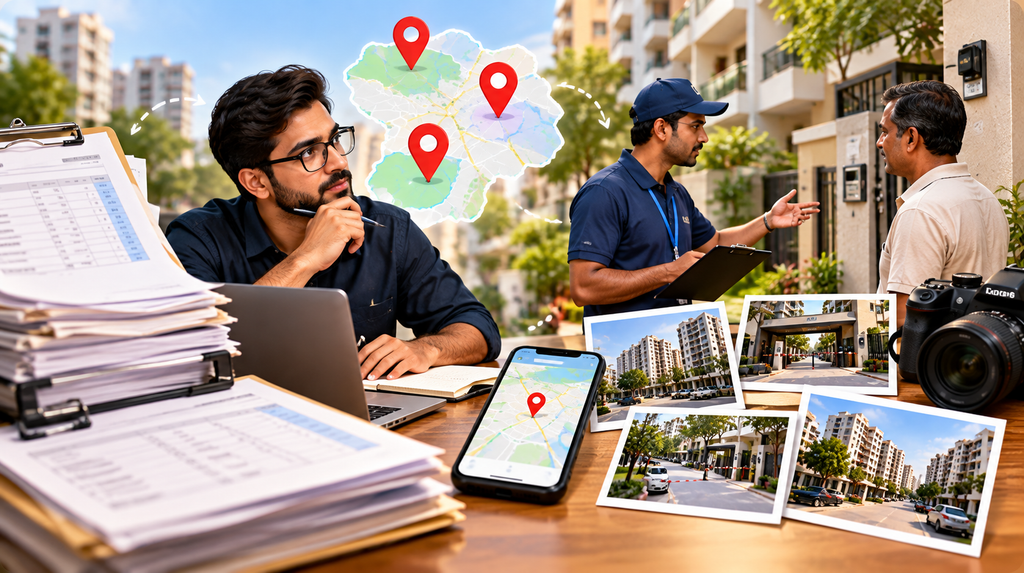
Start with job sheets or invoices from the last six months. Sort by area. The areas with the most entries are your three. Pull the society and building names out of the address fields.
Then ask your field staff. Not “what should we write” — ask what is annoying about working there. Parking. One-way roads. Lift access. Society entry rules. Those answers are the sentences nobody else can write.
Check your Google Business Profile service area while you are there. Google’s guidelines state that “the boundaries of your profile’s overall service area shouldn’t extend farther than about 2 hours of driving time from where your business is based,” though larger areas may suit some businesses. If you have areas listed that your team does not actually reach, fix that before writing a page about them.
Photos are the last source. A photo from a job there, with a filename and alt text naming the area, is original content in the plainest sense.
What does a finished locality page look like, section by section?
Here is the template I use. Copy it as it stands.
| Section | What goes in it | Where you get it | The fail test |
|---|---|---|---|
| H1 | Service + area, in the words people type | Search Console queries, or how customers say it on the phone | Does it read naturally spoken aloud? |
| Opening 40–60 words | What you do here, and how fast you reach it | Dispatch records | Could this sit on another area’s page unchanged? |
| Landmarks and coverage | 5–8 named sub-areas, markets or societies you serve | Invoices, job sheets | Have you been to half of them? |
| Travel time and availability | Minutes from your base, plus a realistic response window | Your team, not your marketing | Would field staff agree with the number? |
| Pricing for this area | Call-out charge, minimum order, or “same as everywhere” | Your rate card | Is there a number on the page at all? |
| Work done here | 2–3 named jobs, with permission, plus photos | Past customers | Are the names real and cleared? |
| Area-specific FAQs | 3 questions that only apply here | Your inbox and WhatsApp | Would they make sense on another page? |
| Contact block | Same NAP as your Google Business Profile | Your GBP listing | Character-for-character match? |
The fail test column is the part that matters. Run every section through it before publishing. If more than two fail, you do not have a locality page yet — you have a template waiting for content.
Keep the page on your own domain, server-rendered, at a clean URL like /areas/vaishali-nagar/. Not a separate microsite — that is the “multiple domain names or pages targeted at specific regions” pattern Google names directly.
A downloadable version sits behind an email form. The table above stays ungated — if a checklist is worth having, it is worth having where people can screenshot it.
When should you skip locality pages entirely?
You serve one area only. Your homepage and Google Business Profile already do this job. A locality page for the city you are physically in usually cannibalises your homepage.
You have no field data. If you cannot fill three of the four differentiators from records you already hold, collect for a quarter first.
Your site is brand new. These pages add depth to a site that already has some authority. On a two-month-old domain they are rarely the constraint. Fix your Google Business Profile and core service pages first — the sequence I use in every local SEO engagement.
You sell nationally with no service radius. Area pages for a business that ships everywhere have nothing true to say.
I have changed my mind on one thing. I used to build locality pages during the initial site build. Now I hold them until the business has six months of job data, because the pages I built from assumptions were the ones I later deleted.
- Explore Now:- Local SEO for Gyms and Fitness Studios in India
Where should you start in the next ten minutes?
Open your last three months of invoices or job sheets and sort them by area. Count the entries.
That count, not keyword volume, tells you which three areas deserve a page. If one area has forty jobs and another has two, you have your answer — and the society names, addresses and photo opportunities are sitting in the same records.
Ten minutes, and it settles a question most people spend a month debating.
If you want the pages built and the field data pulled properly, that is the work I do — see my local SEO services for Indian businesses, or get in touch with what you already have and I will tell you honestly whether locality pages are your bottleneck.
Want More Local Customers?
Boost visibility with targeted locality pages.
Grow Your Local Presence. No obligation. Contact us today.Frequently asked questions
Are locality pages considered doorway pages by Google?
Only when they are near-duplicates. Google’s spam policies name pages “targeted at specific regions or cities that funnel users to one page” as doorway abuse. A page with genuine local detail — named landmarks, real travel time, local pricing, completed work — is not one. The test is whether the content could move to another area’s page unchanged.
How many words should a locality page be?
There is no word count that makes a page safe. I aim for 600 to 900 words because that is roughly what four genuine differentiators plus three area-specific FAQs take up. If you are padding to hit a number, the padding is the problem. A tight 400-word page with real detail beats a 1,200-word page of filler.
Should locality pages live on subdomains or separate domains?
Neither. Keep them on your main domain under a clear path such as /areas/. Google’s spam policies specifically list “multiple domain names or pages targeted at specific regions” as a doorway pattern, and splitting across domains also splits whatever authority you have built. One domain, one clean folder.
Do I need a Google Business Profile for each area I write a page about?
No. Google’s guidelines allow one profile per location with a designated service area, and separate profiles only when you have separate locations with separate staff. Creating profiles for areas where you have no premises risks suspension. Your locality pages and your service area settings should describe the same coverage.
How long before a locality page starts ranking?
Longer than most people expect, and Google publishes no timeline — its guidance says some changes take hours and others several months. In my experience a locality page on an established site shows impressions before it shows clicks, so watch Search Console impressions for that URL rather than waiting for the phone to ring.