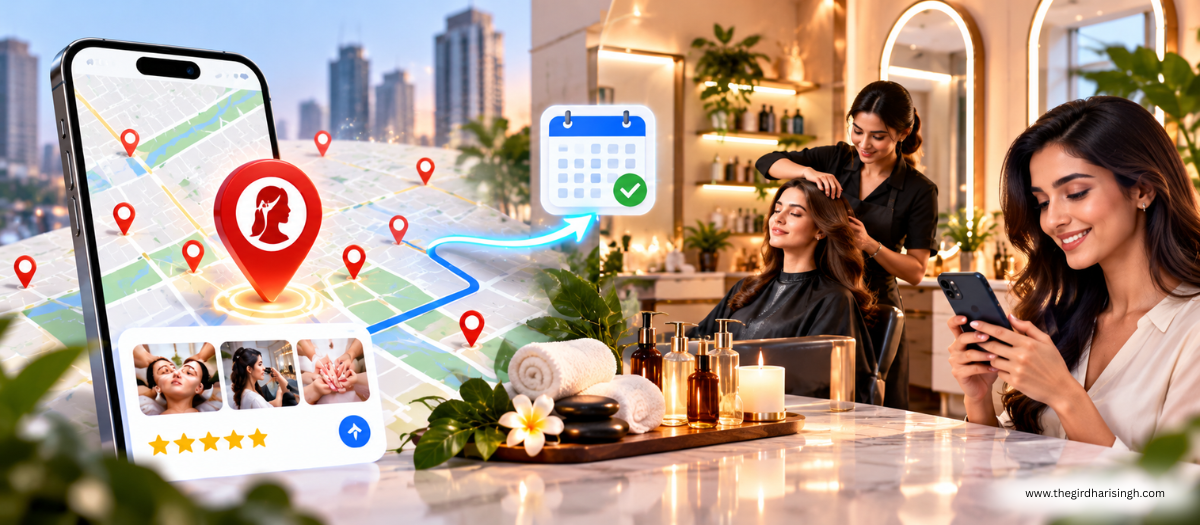
Local SEO for salons turns map searches into bookings when your Google Business Profile lists every service with a price. People compare rates on the map before they call. A salon that shows “Keratin treatment, from ₹3,500” gets chosen over one that says “call for details”. Publishing your rate card is a conversion lever, not a risk.
Most salon owners I talk to hide prices on purpose. A call is a chance to sell, the logic goes, and a price on Google helps the salon next door undercut you.
That logic predates seeing five salons side by side on one screen. A woman searching “hair spa near me” on a Sunday evening isn’t calling five salons for prices. She picks the one that already told her. That’s the shift salon marketing in India hasn’t caught up with.
Why should a salon publish its prices on Google?
Because price is the first filter customers apply, and a listing without prices gets skipped rather than called. Publishing prices costs you some price-shopper calls and wins you customers who’ve already decided.
A salon search on Google Maps shows several profiles at once. The customer compares photos, rating, distance and, where listed, price. A profile with prices answers her on the spot. One without them asks for extra work, and the next listing doesn’t.
There’s a ranking side too. Google’s local ranking guidance names relevance, distance and prominence, and advises complete, detailed business information. Services named the way people search (“bridal makeup”, “hair smoothening”) give Google more to match.
Here’s the claim a competent competitor would argue with: a salon that publishes its full rate card on Google will get fewer calls and more bookings, and that’s the trade you want. Fewer calls means your receptionist stops spending the evening quoting prices to people who were never going to come.
How do you add services and prices to a salon’s Google Business Profile?
Use the services section of your Business Profile, add each service by the name customers search, and fill the price and description fields.
Google’s help page on managing services says businesses in eligible categories can add suggested or custom services, group them, and add details such as price and description. It also says custom service names containing prices or phone numbers are rejected, so put the price in the price field, never in the name.
- Check your primary category. It decides which suggested services Google offers you. “Beauty salon”, “Hair salon” and “Day spa” lead to different suggestions.
- Add secondary categories for real service lines, such as nails or bridal makeup, only if you actually offer them.
- Name services the way customers search. “Hair smoothening” and “keratin treatment” may be the same chair, but people search both. List both if you genuinely do both.
- Add a price to every service. Use a fixed price where it’s fixed and a “from” price where it varies with hair length or product.
- Write a one-line description. Say what’s included, how long it takes and which product range you use.
- Group services into hair, skin, nails, spa and bridal for easy scanning.
If your beauty parlour Google Business Profile shows no services section at all, check the primary category first. That’s the usual cause in my experience.
This is the setup work I do in local SEO for salons and service businesses. For photos, hours and attributes, see my Google Business Profile optimisation checklist.
What should the rate card on your salon website look like?
One page per service category, with prices in text, not a photo of your printed menu. Google, AI assistants and customers can read text; none reliably reads a JPEG of a laminated card.
| Service type | How to show the price | Why |
|---|---|---|
| Fixed services (threading, waxing, manicure) | Exact price | No ambiguity; the customer decides immediately |
| Length-dependent hair services | “From ₹X” with price bands for short, medium, long | Honest range; stops the “it was more at the counter” complaint |
| Product-dependent services (colour, keratin, facials) | “From ₹X”, naming the product range for each band | Customers compare brands as much as price |
| Packages (bridal, pre-wedding, spa days) | Starting package price plus what’s included | Bridal buyers shortlist on inclusions |
| Memberships | Price, validity and what’s covered | Removes the main objection before the call |
Keep profile and website prices identical. When they differ, the complaint lands in your reviews.
If a price can change at the counter, say so upfront. The Central Consumer Protection Authority’s 2023 dark patterns guidelines list “drip pricing” among the practices they cover. They target online platforms mainly, but the principle holds: show the real price early.
- Explore Now:-Local SEO for Restaurants and Cafes in India
How do map views turn into actual bookings?
By making the next step one tap away: a booking link, a WhatsApp chat or a phone that gets answered. A perfect listing still loses the customer if nobody picks up at 7 pm.
Google’s help page on bookings says you can connect a booking provider to your Business Profile, appearing within a week, or add your own booking link.
For many Indian salons, WhatsApp is the real booking channel. That’s fine if someone replies within minutes during opening hours.
The phone is where I see most bookings lost. Salons are busiest exactly when customers call, so whoever should answer is holding a blow dryer.
Do reviews matter more than prices for salons?
Both, at different moments. Reviews get you shortlisted; prices decide who gets booked.
Google says that more reviews and positive ratings can help a business’s local ranking, and that replying to reviews shows you value feedback. In my experience, salon reviews that mention a specific service and stylist (“Priya did my balayage”) do more for future customers than five-star ratings with no text.
Ask right after a service the customer clearly liked, with a direct link. My guide to review management covers the process; it carries over from professional firms to salons.
When should a salon or spa not publish exact prices?
When the price genuinely can’t be known before a consultation, or when professional rules limit how you advertise. Even then, publish a starting price or a consultation fee.
Three cases where I’d hold back exact prices:
- Custom bridal work where the price depends on the look, trial sessions and travel. Publish a starting package price instead.
- Beauty clinics offering medical procedures carried out by doctors. Professional advertising rules may apply, so check with the treating doctors before publishing procedure prices or claims.
- Premium salons built on consultation. Publish a consultation fee so the listing isn’t blank.
It also does less for salons fully booked through regulars. With no empty slots, local SEO isn’t your bottleneck.
How do you plan for wedding season and festivals?
Update services, prices and posts four to six weeks before demand peaks. Bridal and pre-wedding packages, Karva Chauth mehendi and Diwali party makeup are searched before the date, not on it.
Add seasonal services with package prices, publish a matching website page, and set special hours on Google if you’ll open early or late. Google’s guidance specifically mentions keeping special hours accurate.
For the wider picture beyond salons, my guide to local SEO in India covers how map rankings work across categories.
Want More Salon Customers?
Improve local visibility and attract more clients with local SEO.
Grow Your Salon Business. No obligation. Contact us today.Frequently asked questions
What is local SEO for salons?
Local SEO for salons is the work of making a salon or spa appear in Google Maps and local search for nearby customers, and turning those views into bookings. It mainly involves a complete Google Business Profile with services and prices, accurate hours, good photos, steady reviews, a website rate card in text, and a booking or WhatsApp option that is answered.
Should salons show prices on Google Business Profile?
In most cases, yes. Customers compare salons on the map, and a profile with service prices answers their first question without a call. Use exact prices for fixed services and “from” prices for services that vary by hair length or product. Keep profile prices identical to your website and counter prices to avoid complaints.
Why can’t I see a services section on my beauty parlour’s Google profile?
Google offers the services section to businesses in eligible categories, and suggested services depend on your primary category. If you can’t see it, check that your primary category describes your main business, such as “Beauty salon” or “Hair salon”. Google also rejects custom service names that include prices or phone numbers.
Does spa SEO work differently from salon SEO?
The basics are the same: category, services with prices, photos, reviews and bookings. Spas usually sell longer, higher-value treatments and packages, so descriptions should state duration, what’s included and the therapy type. Spa customers also check hygiene and ambience, so recent interior photos matter more than they do for a quick-service salon.
How long does local SEO take for a salon?
Profile fixes such as categories, services, prices and hours can affect calls within weeks, because they change what customers see immediately. Ranking improvements usually take longer, often a few months, depending on competition nearby, review growth and how complete your profile was to begin with. Results differ a lot between a busy city market and a smaller town.