Classic SEO still works in 2026, but it no longer ends at a ranking. AI search SEO 2026 means competing for two outcomes at the same time: ranking in Google’s results, and getting quoted inside AI answers from Google’s AI Overviews, ChatGPT, Gemini, and Perplexity. Your existing SEO investment is not wasted, because both systems read the same things — crawlable pages, clear answers, topical depth, and how credible the rest of the internet says you are. What has changed is where the value sits. Informational traffic is shrinking, the citation itself has become the asset, and the work shifts from writing longer pages to writing quotable ones.
That’s the short answer. Here’s the part that changes what you actually do this month.
Is classic SEO still worth the money in 2026?
Yes, and for a mechanical reason rather than a sentimental one.
AI answers are not generated from thin air. When someone asks ChatGPT or Gemini a question with any real-world specificity (“best orthodontist in Jaipur”, “GST software for a 12-person firm”), the model runs a search, reads a handful of pages, and summarises them. Google’s AI Overviews do the same thing against Google’s own index.
So the pipeline is still: get crawled, get indexed, get judged credible, get retrieved. Every one of those steps is classic SEO. If your site is slow, thin, badly structured, or invisible to crawlers, you are invisible to the AI layer too. There is no shortcut around the index.
What has stopped working is the business model a lot of agencies sold you: publish 8 blog posts a month, rank for long-tail informational keywords, watch sessions climb, report the sessions as the result. That funnel is leaking, and it was always the weakest part of your SEO anyway.
What actually changed: how AI engines decide who to quote
This is the part most articles skip, and it’s the part that matters.
A ranking system picks an order. A generative system picks sentences. Those are different jobs, and they reward different writing.
When an AI engine assembles an answer, it needs a passage it can lift with almost no editing. A clean 40-word definition that answers the question completely, in one place, with no dependency on the paragraph before it. If your answer is spread across 600 words of build-up, storytelling, and “let’s first understand the basics,” it doesn’t get lifted. A competitor’s tighter page does.
Here’s the practitioner version of that insight, and it’s counterintuitive: in AI search, the 3,000-word “ultimate guide” often loses to a 900-word page that states things plainly. Comprehensiveness helps you rank. Extractability gets you cited. Most business sites are optimised for the first and terrible at the second.
The second change is bigger and harder to control. AI answers are built from consensus across multiple sources, not from your site alone. When I check the citation sets behind AI answers for a client’s category, the majority of cited URLs are usually pages the client doesn’t own — directories, review sites, Reddit threads, “top 10 in [city]” listicles, industry publications, LinkedIn posts.
Which means you can have a perfect website and still be described wrongly, or left out entirely, because the internet’s version of you disagrees with yours. Fixing your own copy does not fix that. This is the single biggest gap between what businesses are doing and what actually moves AI visibility.
Which of your pages are losing traffic, and which are safe?
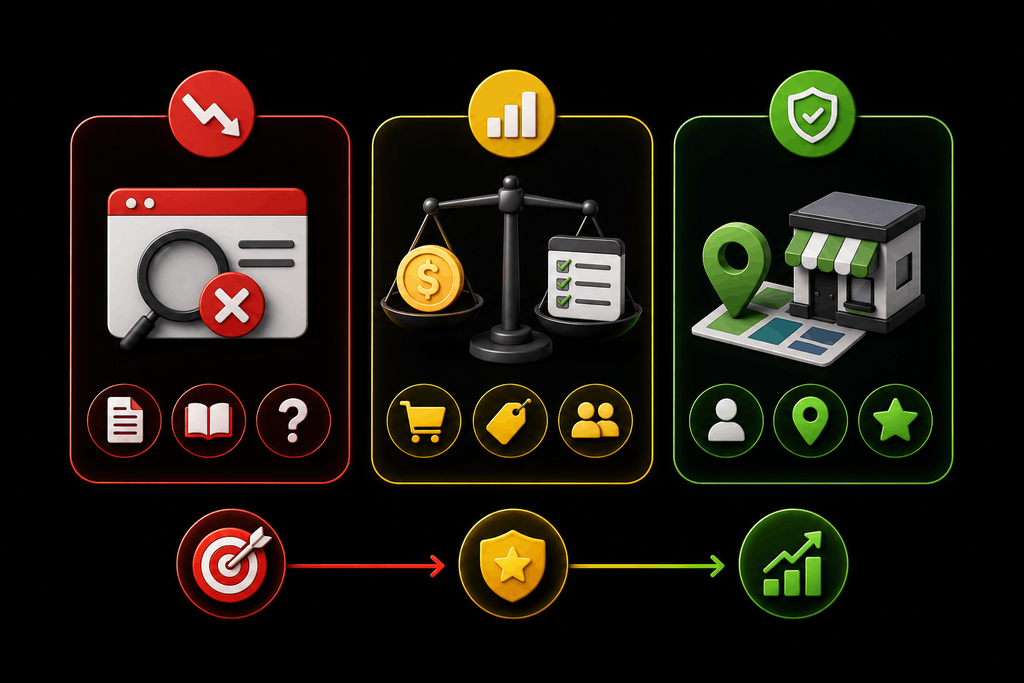
Not all of your SEO is equally exposed. Sort your pages into three buckets and the AI Overviews impact stops feeling like a vague threat.
Losing traffic (accept it): definitional and how-to informational pages. “What is root canal treatment”, “difference between CAT and XAT”, “what is a Section 8 company”. These get answered in the AI panel and the user never clicks. This traffic looks big in Analytics and converts close to zero. You are losing volume, not revenue.
Holding steady: commercial and comparison intent. “Invisalign cost in Jaipur”, “best CA firm for startup compliance”, “Zoho vs Freshworks for a 20-seat team”. People spend money after these searches, so they still want to see options, prices, reviews, and a real business behind the answer. AI panels often appear here too, but the click-through survives because the buyer wants to verify.
Barely affected: branded, navigational, and local-intent searches. Someone searching your name, or “physiotherapist near me” on a phone, still lands in the map pack and on your site. If you run a clinic or a local practice, your Local SEO foundation is the most durable asset you own right now.
The strategic move follows directly from that split. Stop trying to win clicks from the pages AI has taken over. Deliberately optimise those pages to be cited instead, so the answer carries your brand name into a moment where the reader is forming an opinion. Then defend clicks hard on the commercial pages, where money actually moves.
What is generative engine optimization, and is it different from SEO?
Generative engine optimization (GEO) is the practice of getting your business represented accurately inside AI-generated answers. Answer engine optimization (AEO) is the narrower, older version of the same idea: structuring content so it can be extracted as a direct answer.
They are not a replacement for SEO. They are a layer on top of it, and roughly 70% of the work overlaps with what good SEO already required. The genuinely new 30% is this:
- Writing in liftable units instead of long flowing sections
- Managing your description across third-party sources, not just your site
- Making entity facts (who you are, what you do, where, for whom) consistent everywhere a machine can read them
- Monitoring AI answers as a ranking surface, because nobody reports them to you by default
Anyone selling GEO as a brand-new discipline with a brand-new price tag is selling you repackaged technical SEO plus content editing. Anyone telling you SEO is unchanged is not looking at the answer panels.
What’s different about answer engine optimization in India?
Three things, and they’re practical.
Distribution came fast and free. Airtel bundled Perplexity Pro for its subscribers, and AI assistants ship inside the phones and browsers most of your customers already use. Adoption here didn’t wait for people to develop a habit of visiting a website. For a lot of first-time internet users, the assistant is the search engine.
Queries are messier. Real Indian search behaviour is Hinglish, voice-first, and long. “Ghutne ka dard doctor Jaipur near me” is a real query shape. Voice and conversational input reward pages that answer full spoken questions, which is exactly what AI extraction rewards too. Optimising for one gets you the other.
Local trust still runs on reviews and Google Business Profile. When an AI assistant recommends a dentist or a coaching institute in an Indian city, it leans heavily on Google’s local data and on review sentiment it can read. Thin review profiles get skipped in the summary even when the website is excellent. Your reviews and reputation work is now AI visibility work, whether or not anyone framed it that way.
The 10-point AI search readiness checklist
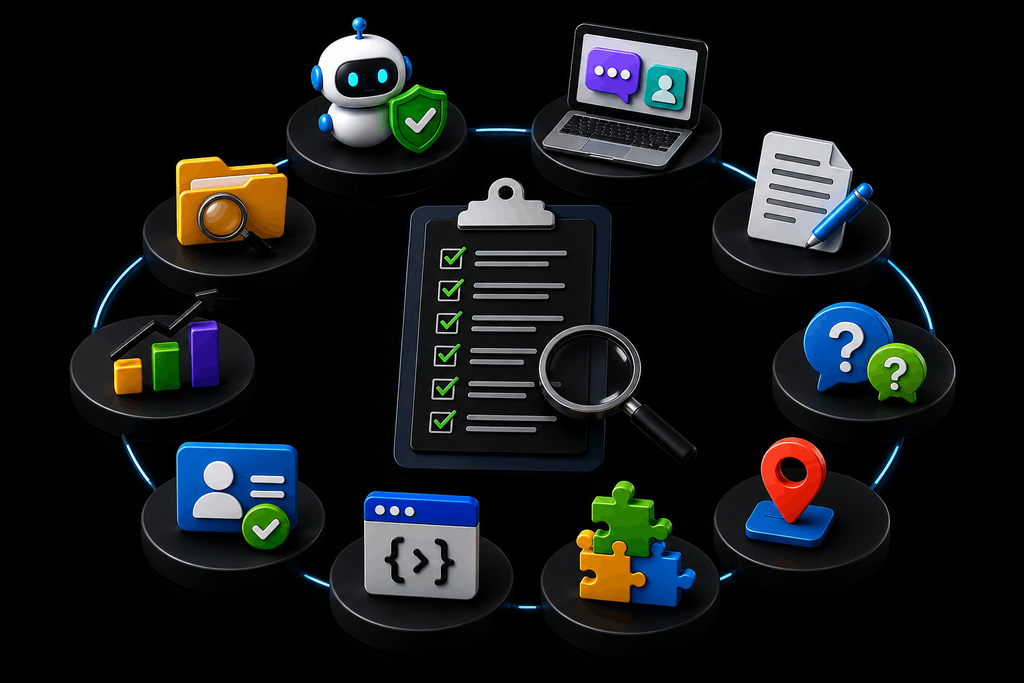
Run this on your own site this week. It’s the sequence I’d use on a new account.
- Confirm AI crawlers can reach you. Check robots.txt for blocks on GPTBot, ClaudeBot, PerplexityBot, and Google-Extended. If somebody blocked them “for safety” in 2024, you opted out of the answer layer.
- Ask the engines about yourself. Query ChatGPT, Gemini, and Perplexity for your five most valuable commercial questions. Record who gets cited. This is your real competitive set now, and it is often not who ranks #1.
- Add a direct answer block to your top 20 pages. Two to four sentences, immediately under the H1 or the relevant H2, that answer the page’s core question completely with no context needed.
- Rewrite headings as questions people actually ask. Not “Our Approach”. “How long does SEO take to show results?”
- Audit your off-site description. Search your business name plus your category. Check what directories, listicles, and forums say about you. Correct anything wrong, stale, or missing.
- Fix entity consistency. Same business name, same service names, same city, same founder name across your site, Google Business Profile, LinkedIn, and every directory. Machines resolve conflicts by dropping the confusing entity.
- Implement Organization, Person, Service, and FAQPage schema. Schema doesn’t magically get you cited, but it removes ambiguity about what you are.
- Put a real author on your content. Named human, credentials, linked profile. Expert-led businesses have the biggest advantage here and usually waste it on “Admin” bylines.
- Publish something only you could publish. Original data, a real teardown, a specific client scenario, a price breakdown competitors avoid. AI summarisation flattens generic content and preserves specifics.
- Set up citation tracking. Even a monthly manual log of which AI answers mention you beats having no visibility at all.
What goes wrong when businesses react badly to this
Four failure patterns, all of which I’ve watched play out.
Blocking AI crawlers. It feels protective. It functions as a decision to not exist in the fastest-growing discovery channel.
Doubling content volume with AI writing. More generic pages is the exact opposite of the fix. Generative engines compress generic material into nothing and cite whoever added something specific.
Panicking at a traffic drop that doesn’t matter. A clinic I’d describe as typical loses a third of its blog sessions and none of its consultation enquiries, because the lost sessions were students doing homework on “symptoms of vitamin D deficiency”. Check enquiries before you change strategy.
Chasing citations on money pages. Being quoted for “Invisalign cost in Jaipur” without a click is a worse outcome than ranking third with a click. Some queries you want to win with a click, and your conversion rate optimisation work is what makes that click pay.
How do you measure any of this when clicks go down?
Move your reporting one layer closer to revenue and one layer wider than Google.
Track branded search volume, direct traffic, and enquiry volume as your real demand signals. AI answers create demand without a referral, so it surfaces as somebody typing your name later. Watch impressions versus clicks in Search Console: rising impressions with falling clicks on informational queries is the AI Overviews impact showing up in data, and it’s usually fine. Then log AI citations manually for your top queries, and ask every new lead where they heard about you. That last one is unglamorous and currently more accurate than any tool.
Get Found in AI Search
Increase your visibility across AI-powered search.
Boost Your AI Visibility No obligation. Straight talk only.Your Questions Anwered
Is SEO dead in 2026?
No. AI search engines retrieve and summarise indexed web pages, so being crawlable, credible, and well-structured still determines whether you appear at all. What has declined is the value of high-volume informational blog traffic, which rarely converted. Commercial, local, and branded search still deliver clicks and revenue.
What is the difference between SEO, AEO, and GEO?
SEO earns visibility in search rankings. AEO (answer engine optimization) structures content so an engine can extract a direct answer from it. GEO (generative engine optimization) works to get your business accurately represented inside AI-generated answers, including on sources you don’t own. They share the same technical foundation and differ in how content is written and measured.
Should I block AI crawlers from my website?
Only if you have a specific reason, like protecting proprietary data or paid content. For most businesses, blocking AI crawlers removes you from AI answers while your competitors stay visible. Publishers with licensing leverage are a different case from a clinic or a SaaS company.
Does schema markup help with AI search visibility?
Indirectly. Schema doesn’t force a citation, but it removes ambiguity about your identity, services, location, and authorship, which makes you easier to retrieve and quote correctly. Organization, Person, Service, and FAQPage are the ones worth prioritising.
How long does it take to see results from AI search optimisation?
Technical and structural fixes can change how you’re quoted within a few weeks, because AI engines re-read pages frequently. Shifting off-site consensus, reviews, third-party mentions, and entity clarity takes three to six months, which is the same timeline good SEO always had.