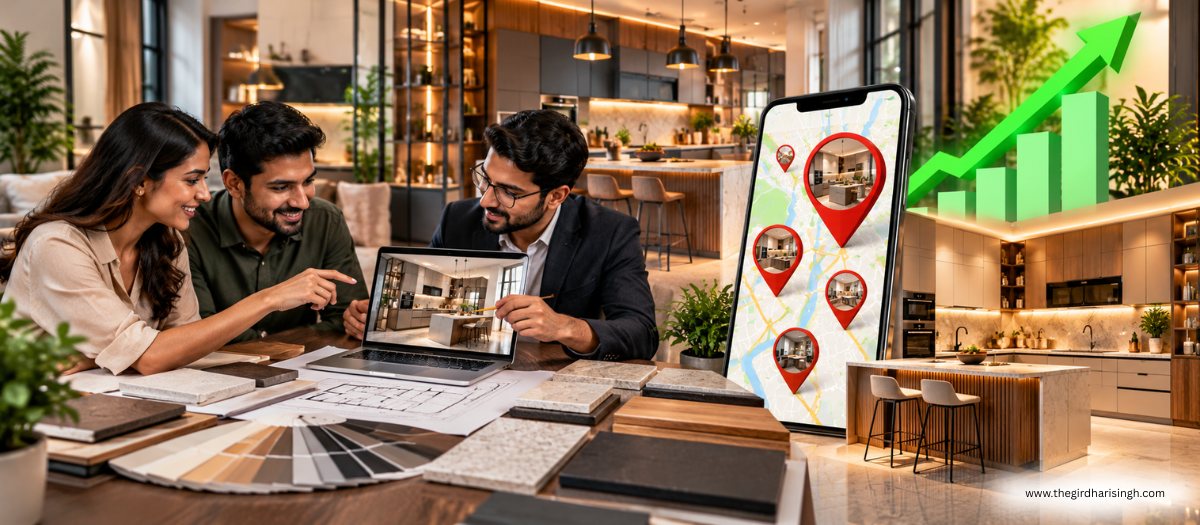
Local SEO for interior designers works best when every finished project gets its own page, named by locality and flat size, such as “3BHK interiors in Vaishali Nagar”, with photos, scope and a budget band. Those pages match how buyers search, rank where portfolio grids don’t, and filter out enquiries that can’t afford you.
Most interior design websites I audit have the same structure. A home page, an about page, a services page, and one “Portfolio” page with 40 photos in a grid. That grid holds the best work the studio has done, and it ranks for nothing.
Interior design is a high-ticket, long-consideration purchase. People look for months before they call. They want proof you’ve done a home like theirs, in an area like theirs, at a budget like theirs. A grid can’t say any of that, and that’s the gap I keep seeing in interior designer marketing in India.
Why do project pages outrank a portfolio grid?
Because a project page answers a specific search and a grid answers none. Someone typing “3BHK interior designer Mansarovar” wants a 3BHK, in Mansarovar. A page with that in its title, heading and text is a direct match. A grid titled “Our Work” isn’t.
Google’s local ranking guidance says local results are based on relevance, distance and prominence, and defines relevance as how well a listing matches what someone is searching for. A page per project gives Google one more precise thing to match.
Images work the same way. Google’s image SEO guidance says Google uses alt text, the page’s content and nearby text to understand what an image shows. A grid of photos named IMG_4021.jpg with no text around them gives Google almost nothing. The same photos on a page about a 3BHK in a named locality, with captions, give it plenty.
Here’s the claim plenty of competitors will push back on: ten project pages with locality, flat size and a budget band will win you more signed projects than a hundred-photo portfolio, even if the portfolio looks better. Looking better doesn’t help if nobody lands on it.
What should a “3BHK interiors in [area]” page include?
Enough detail that a buyer with a similar home can judge fit without calling you. I build each page in this order:
- Title and H1 with flat size, scope and locality. “3BHK full home interiors in Vaishali Nagar, Jaipur”, not “The Sharma Residence”.
- A two-line summary. Flat size, rooms covered, and the timeline from design sign-off to handover.
- Budget band. A range, not an exact figure.
- Before-and-after photos with captions. Describe the room and the decision: “Kitchen moved to an L-shape to free up the dining wall.”
- Materials and brands used. Laminate, veneer or acrylic, the hardware brand, the countertop.
- What was hard. A beam that dictated the false ceiling. A society rule on work hours. Competitors rarely write this part, and it’s what shows real experience.
- One clear next step. WhatsApp or a consultation form, placed after the photos, not before.
Get written consent before you publish a client’s home. Name the locality, and the society only if the client is comfortable. Never publish a flat number.
If you’re new to building pages around areas, my locality pages guide covers how to avoid thin, copy-paste pages. Project pages are the strongest kind of locality page, because the proof is real.
Should interior designers put prices on their website?
Yes, as a budget band per project, not a rate card. Pricing is the objection I hear most in this vertical, and hiding it doesn’t make it go away. It moves it to the first call, where you spend 20 minutes with someone whose budget is a third of your minimum.
The fear is that competitors will undercut you. In my experience, buyers who choose on price alone were never going to sign with a premium studio anyway. A line like “This project: ₹X–₹Y lakh, including modular kitchen and wardrobes” does three jobs. It sets expectations. It filters out mismatched budgets before they cost you a site visit. And it signals you’re not hiding anything.
What I don’t recommend is a per-square-foot price on the home page. Interior costs depend on scope, material and finish. A single “starting at ₹X per sq ft” gets quoted back at you for jobs it never applied to.
The trade-off is real: you’ll get fewer enquiries. If your sales team is judged on call volume, that will feel like a loss for the first month or two.
How is local SEO different for modular kitchen businesses?
Modular kitchen buyers search narrower and decide faster than full-home interior buyers. They search by layout, material and area: “L-shaped modular kitchen Jaipur”, “acrylic kitchen shutters price”, “modular kitchen near me”.
That changes the page structure. For modular kitchen SEO, I build pages around three things:
| Page type | Example | What it does |
|---|---|---|
| Layout pages | L-shaped, U-shaped, parallel, island | Matches layout searches; show installed examples of each |
| Material pages | Acrylic, laminate, PU, membrane | Answers comparison searches; state durability and care honestly |
| Project pages by locality | “Parallel kitchen in Malviya Nagar, 2BHK” | Proves you’ve installed in that area and that flat type |
Showroom-led kitchen brands have one advantage designers don’t: a place customers can walk into. Make sure the showroom is on Google Business Profile with correct hours, and that the website says what’s on display.
If you’re a franchise of a national kitchen brand, check who controls your Google Business Profile before you spend on SEO. Sometimes the parent company manages it, and you can’t change much.
- Explore Now:-Local SEO for Restaurants and Cafes in India
What should your Google Business Profile show to get interior design leads?
Services named the way people search, with prices where possible, plus recent project photos. Google’s help page on managing services says businesses in certain categories can add services with a price and description. It also says custom service names containing prices or phone numbers get rejected, so keep prices in the price field.
List services separately: “Full home interiors”, “Modular kitchen”, “Wardrobes”, “False ceiling”, “Turnkey 2BHK interiors”. Each one is another way to match a search. This profile setup is the first thing I do in local SEO for interior designers and kitchen brands.
The same local ranking guidance says more reviews and positive ratings can help local ranking. In interiors, ask for the review at handover, when the client is standing in the finished room. Reviews that mention the locality and scope (“did our 3BHK in Mansarovar”) help the next buyer most.
The listing gets them interested. The website closes them. If enquiries arrive but don’t turn into site visits, the problem is often the page, not the ranking. That’s conversion rate optimisation work, not more SEO.
When is local SEO the wrong investment for an interior designer?
When referrals already fill your calendar, or when your clients won’t let you show their homes. Without publishable projects, the project-page approach has nothing to stand on.
Three cases where I’d tell you to hold off:
- You’re booked months out through referrals. More enquiries won’t help. Fix capacity first.
- Your clients are mostly high-profile people who want privacy. You can’t build project pages without projects you’re allowed to show.
- Nobody answers the phone or WhatsApp within a few hours. Ranking will just send leads to a closed door.
For everyone else, the work is steady, not fast. Google’s guidance on creating helpful content asks whether content shows first-hand expertise and original information. A real project page, written by the person who designed the kitchen, is exactly that.
For how map rankings work across categories, see my guide to local SEO in India.
Want More Interior Design Clients?
Improve local visibility and attract more clients with local SEO.
Grow Your Interior Design Business. No obligation. Contact us today.Frequently asked questions
What is local SEO for interior designers?
Local SEO for interior designers is the work of appearing in Google Maps and local search when nearby homeowners look for interior or modular kitchen services. It covers a complete Google Business Profile, steady reviews, and a website with project pages named by locality and flat size, so a search like “3BHK interior designer in [area]” finds a matching page.
How do interior designers get leads from Google?
Mostly through two routes: the Google Business Profile in map results, and website pages that match specific searches. Project pages that name the locality, flat size, scope and budget band tend to bring better-fit interior design leads than a portfolio grid, because the buyer already knows you’ve done a similar home at a similar budget before calling.
Should a modular kitchen business show prices online?
Show starting prices or ranges per layout or material, and budget bands on project pages. A single per-square-foot rate causes problems, because the real cost depends on size, material, hardware and countertop. Ranges answer the buyer’s first question without a call and filter out enquiries far below your minimum, at the cost of fewer total enquiries.
How many project pages does an interior designer need?
There’s no fixed number. Start with five to ten recent projects that clients have agreed to show, prioritising the localities and flat sizes you want more of. Each page should be genuinely different, with its own photos, scope, timeline and challenges. Ten real project pages will do more for you than fifty thin ones that repeat the same text.
How long does local SEO take for interior designers?
Google Business Profile fixes such as services, categories and photos can affect enquiries within weeks. Project pages usually take a few months to rank, depending on how competitive your city is and how established your site is. Because interior projects have long decision cycles, expect signed projects from SEO to lag well behind the first enquiries.
Where to start
Take ten minutes. Search “3BHK interior designer” plus your main locality on your phone and look at the top results. Note whether any competitor has a page about a specific project in that area. Then open your own portfolio page and ask: could Google tell which locality or flat size any of these photos belong to? If not, that’s your first fix.
If you’d like me to look at your portfolio and Business Profile and tell you which projects to turn into pages first, get in touch. I’ll also tell you if local SEO isn’t your real bottleneck.