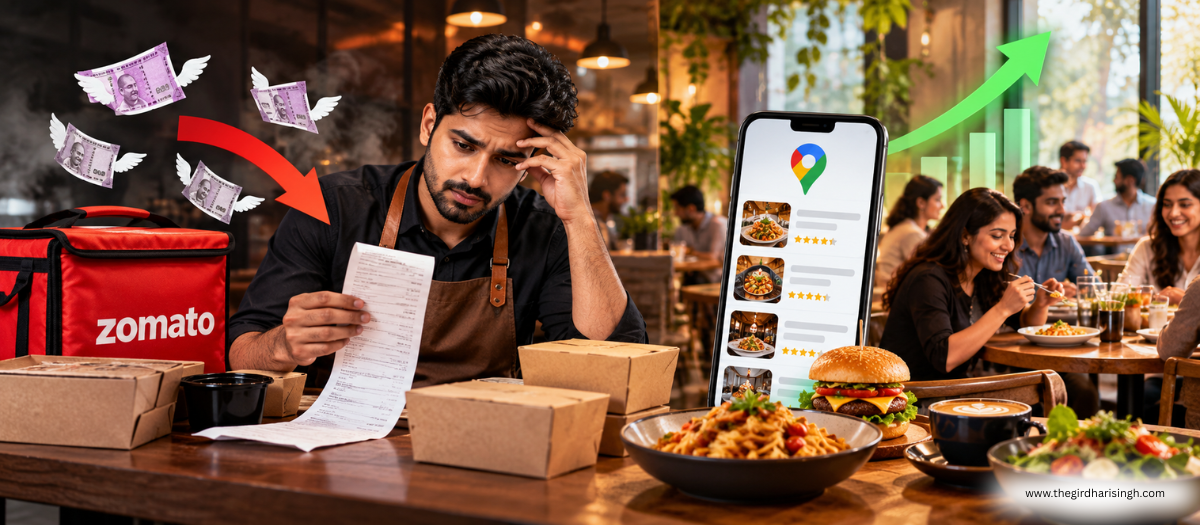
Local SEO for restaurants in India means owning your Google Business Profile — menu, photos, hours, reviews and an order link you control — so “near me” and branded searches reach you directly instead of through Zomato or Swiggy. Done right, it moves repeat and branded orders to direct channels like WhatsApp, where you keep the whole bill.
Why should a restaurant care about local SEO if Zomato and Swiggy already bring orders?
The first job is discovery: a stranger in your delivery radius finds you. That’s worth paying for. The second job is fulfilment for someone who already knows you. That person typed your restaurant’s name, and the aggregator still takes its cut.
Here’s the claim plenty of marketers will argue with: the most expensive order on an aggregator is the one from a customer who searched for you by name. You didn’t need the platform to find them. You paid commission anyway.
So the question isn’t “should we leave Zomato?” For most places, no. The question is which orders you’re paying discovery rates for when no discovery happened. That’s a margin decision.
Pull your last payout statement. Add commission, any tax on commission, ad spend on the platform and the discounts you funded. Divide by order count. That’s your real cost per aggregator order, and it’s the number your direct channel has to beat.
- Explore Now:-Local SEO for Salons and Spas
Which orders should go direct, and which should stay on the aggregator?
| Order type | Where the demand came from | Best channel |
|---|---|---|
| New customer browsing “biryani near me” in the app | The aggregator | Keep on aggregator |
| Customer who searched your restaurant’s name on Google | Your brand | Google Business Profile → your own order page |
| Repeat customer ordering the same thing every week | Your food | |
| Bulk or party order | Your reputation | Phone or WhatsApp, always direct |
| Dine-in or walk-in at a cafe | Google Maps and footfall | Google Business Profile |
The direct route has costs too. You handle delivery or a delivery partner, payment collection, and the phone ringing during service. If you can’t answer WhatsApp at 9 pm on a Saturday, a direct channel will lose you customers, not save you money.
What does Google actually use to rank a restaurant on Maps?
Google names three factors in its guidance on improving local ranking: relevance, distance and prominence. Relevance is how well your profile matches the search. Distance is how far you are from the searcher. Prominence is how well-known you are, and Google says more reviews and positive ratings can help.
Relevance starts with your primary category. Pick the most specific one that’s true — “South Indian restaurant” beats “Restaurant” if that’s what you serve. Then fill the menu, attributes and description with the dishes people actually search for.
Prominence is mostly reviews and how you reply to them. I’ve covered how much weight reviews carry in why Google reviews are a ranking factor in 2026. If you want the full picture of how this plays out across Indian cities, start with my guide to local SEO in India.
How do I set up Google Business Profile to take orders directly?
This is the order I work in, because each step depends on the one before it.
- Set hours to your dine-in hours. Google’s Business Profile guidelines say restaurants should use the hours diners can sit down and eat. Takeout hours come next, delivery hours last.
- Build the menu in the menu editor. Google’s menu editor is available to food and drink businesses. Add sections, item names, descriptions and prices. Changes can take 24–48 hours to show on Maps and Search.
- Fix the menu link. The guidelines state that menu URLs can’t be direct links to third-party ordering or delivery services. Point it at a menu page on your own website.
- Open Food ordering and set a preferred provider. Google’s page on managing online ordering options lets you mark a provider as “Preferred for pickup” or “Preferred for delivery.”
- Add your own “Place an order” link. Outside the US, you can add links to web pages where customers can order. Send it to your own order page, which can hand off to WhatsApp.
One trap: turning off “Accept orders on your profile” hides your own links as well as third-party ones. Don’t use that switch to push people off Zomato.
If you’d rather have this set up and audited for you, that’s what my local SEO service covers.
Why do menu markup, photos and Popular Times matter more for restaurants?
Because a restaurant listing is the menu, the photos and how busy it looks. Most other businesses have one of these. You have all three.
Menu markup. Google says it may transcribe menu data from your website. Make that data clean. On your site, use the most specific LocalBusiness subtype — Restaurant, CafeOrCoffeeShop — with menu and servesCuisine, both listed as recommended properties in Google’s local business structured data docs.
Photos. Customers can add dish photos and names to your listing. Google’s help page on managing dish names says names you add take precedence over customer-added ones. Name your top dishes yourself. In my experience, a steady trickle of fresh photos does more than one big upload a year. My Google Business Profile photos guide has the shot list.
Popular Times. You can’t edit it. Google’s page on popular times and wait times says it comes from anonymised Location History data, averaged over the last few months. What you control is accuracy: if your hours are wrong, a customer sees “usually busy” and a closed shutter.
How do cloud kitchens get on Google without a dining room?
Carefully. Google’s guidelines say virtual food brands are permitted with conditions.
- Each delivery-only brand needs its own branded packaging and its own website.
- Delivery-only brands must hide their address and add service areas instead.
- Several brands at one kitchen face extra verification.
- Co-located brands that show an address need permanent, separate signage and must offer pick-up to all customers.
If you run four brands from one kitchen with one shared box, Google’s rules aren’t on your side. In that case, the aggregators are your storefront, and WhatsApp repeat ordering is where your direct margin comes from.
How does WhatsApp turn a one-time customer into a direct repeat order?
WhatsApp Business has catalogs that let you list items with a price, description and product code, viewable inside the chat. For a restaurant, that’s a menu people can reorder from without opening an app.
Put the WhatsApp QR code on your bill, your table tent and your own delivery packaging. Before you put it in aggregator-delivered bags, read your partner agreement. Some platform terms restrict this, and I’d rather you check than guess.
When is local SEO not worth it for a restaurant?
When you have no brand demand yet. A three-month-old cloud kitchen with no repeat customers gets almost every order through discovery, and aggregators are the right place to pay for that.
It’s also not worth it if nobody will answer the phone or WhatsApp during service. A direct channel you can’t staff is worse than none.
For a cafe or dine-in restaurant with regulars, it nearly always pays. That’s the case I take on through my local SEO work for Indian businesses.
Want More Restaurant Customers?
Improve local visibility and attract more diners with local SEO.
Grow Your Restaurant Business. No obligation. Contact us today.Frequently asked questions
What is local SEO for restaurants?
Local SEO for restaurants is the work of making your restaurant show up on Google Maps and in “near me” searches. It covers your Google Business Profile category, hours, menu, photos and reviews, plus menu and location markup on your website. The goal is for nearby and branded searches to reach you directly, not only through delivery apps.
Can a restaurant in India take orders directly from Google Business Profile?
Yes. Google’s ordering settings let businesses outside the US add “Place an order” links to their own ordering pages and choose a preferred third-party provider for pickup or delivery. Your own link can lead to an order page that hands off to WhatsApp, so you collect payment and keep the full bill.
Should I stop using Zomato and Swiggy?
Usually not. Aggregators are good at reaching new customers who don’t know you yet. The margin win comes from moving branded and repeat orders to direct channels, not from leaving. Compare your real cost per aggregator order against the cost of running direct delivery before you change anything.
Can a cloud kitchen have a Google Business Profile?
Yes, with conditions. Google permits delivery-only virtual brands if each has its own branded packaging and website. Delivery-only brands must hide their address and list service areas. Several brands at one kitchen face extra verification, and co-located brands showing an address need separate permanent signage.
Can I change the Popular Times graph on my listing?
No. Google says Popular Times comes from anonymised Location History data averaged over the last few months, and you can’t add it manually. What you can control is accurate opening hours, so the graph and the “open now” status don’t send customers to a closed restaurant.
Where should you start?
Take ten minutes tonight. Search your restaurant’s name on Google Maps on your phone and tap “Order online.” Note which provider shows first, and whether your own ordering link appears at all. If a stranger’s app is the first thing your own fans see, that’s your margin leaking.
If you’d like a second pair of eyes on what you find, send me a message and I’ll tell you honestly whether it’s worth fixing.