If your rankings are flat but your organic leads are falling, the click is being absorbed before it ever reaches you. Google’s AI Overview answers the question directly on the results page, the buyer reads it and stops, and your page collects an impression instead of a session. B2B SaaS AI search visibility now depends on whether you’re cited inside that answer, not on where you sit in the ten blue links underneath it.
That’s the whole mechanism, and it’s the practical difference between SEO, AEO and GEO — ranking for a query and being the answer to it are no longer the same job. What makes it hard to spot is that every ranking report you look at will tell you nothing is wrong.
Why do my rankings look fine while organic leads drop?
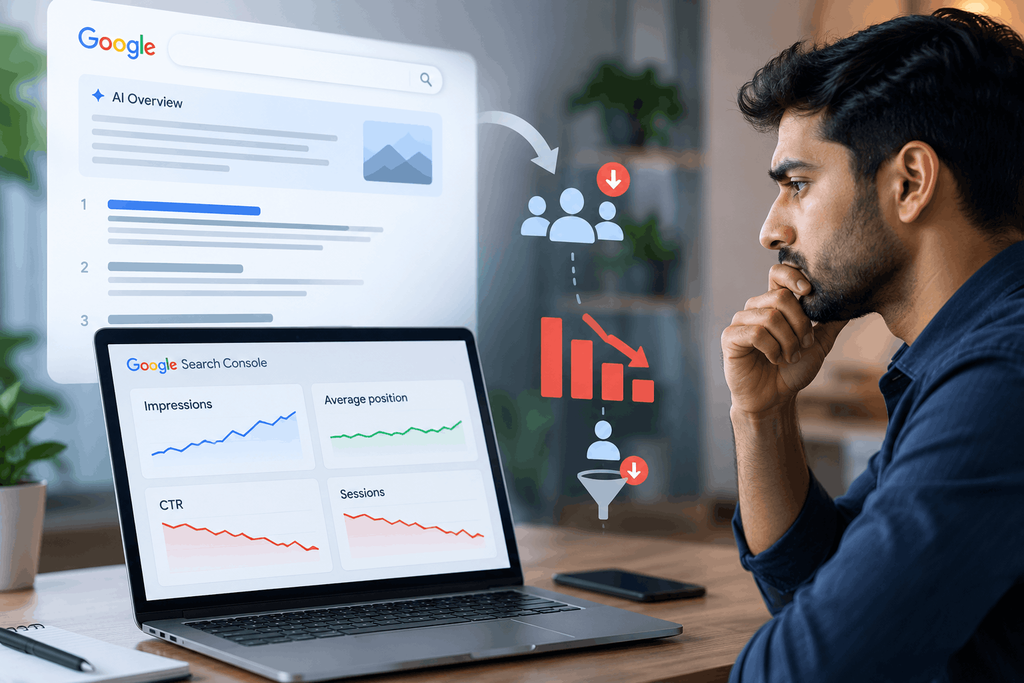
Because Search Console counts an AI Overview appearance as an impression. If your page is on the results page at all — cited in the Overview, or sitting at position 3 below it — you get the impression and your average position holds steady or even improves.
What changes is clickthrough. Ahrefs studied 300,000 keywords and found the presence of an AI Overview correlated with a 34.5% lower CTR for the top-ranking page. SparkToro’s clickstream analysis of January–April 2026 put US zero-click searches at 68.01%, up from 60.45% in 2024.
So the signature of this problem is very specific: impressions flat or up, average position flat, CTR down, sessions down. If you’re staring at a ranking tracker instead of that four-line combination, the problem is invisible to you — and it is the single most common blind spot in AI search SEO reporting right now.
The second reason it fools people is the lag. The queries that go first are informational — the “what is”, “how does X work”, “X vs Y” content at the top of your funnel. Those pages weren’t producing demo requests last week anyway. They were feeding your retargeting pools, your newsletter, and your brand recall. Pipeline drops a quarter after the traffic does, and by then most teams have stopped connecting the two.
How do I confirm AI Overviews are actually the cause?
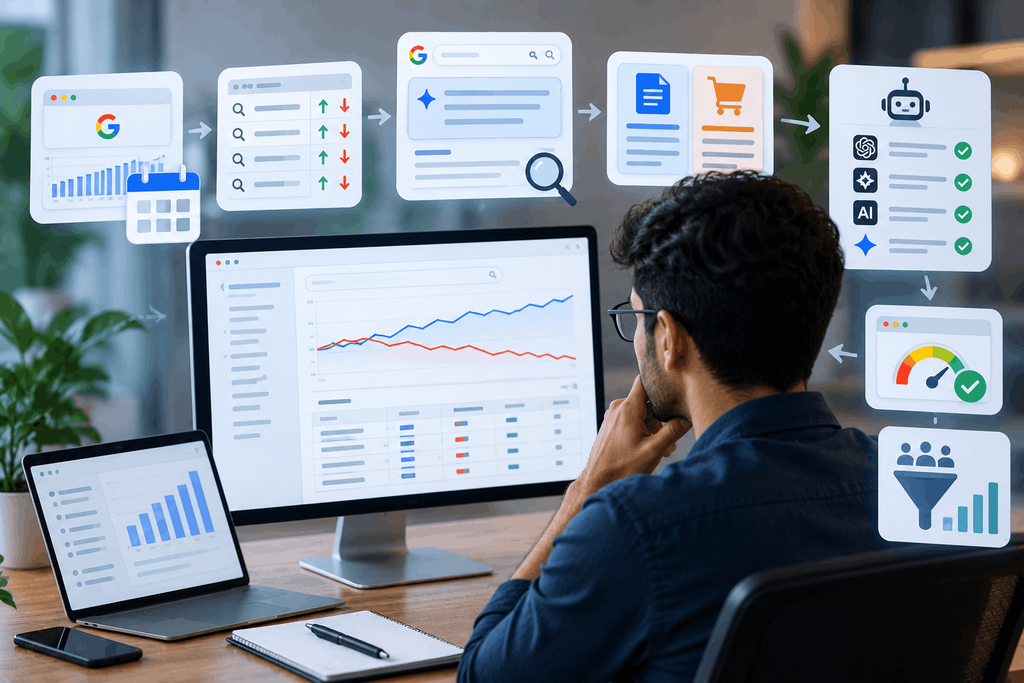
Run this before you change anything. It takes an afternoon and it rules out the other things that look identical.
- Pull 16 months of Search Console data for your blog and resource subfolders, split by query. You need a pre-rollout baseline to compare against.
- Segment by CTR change, not position change. Sort by queries where impressions rose or held and clicks fell. That delta is your suspect list.
- Manually search your top 20 declining queries in an incognito window from your target country. Note which return an AI Overview and whether your domain is cited in it.
- Split the list by intent. Informational queries losing clicks is expected. Commercial-intent queries losing clicks is the expensive one — Semrush found AI Overviews on commercial-intent keywords grew 71% between November 2025 and April 2026, while transactional-intent coverage actually fell 5%.
- Check server logs or your CDN for AI crawler hits: GPTBot, PerplexityBot, ClaudeBot, Google-Extended. If they’re being blocked at robots.txt or your firewall, you’ve found a self-inflicted problem worth fixing this week.
- Rule out the boring causes. A Core Web Vitals regression, a botched migration, seasonality, or a competitor’s new page can all produce a traffic drop. Only the impressions-up-clicks-down pattern points squarely at Overviews.
- Segment your form fills by landing page, not by channel. You will usually find that total leads fell less than traffic did, because what you lost was the least qualified layer. If form fills fell faster than traffic, you have a conversion rate optimisation problem sitting underneath the traffic one, and AI Overviews are not your main story.
That last point is the one worth sitting with.
What most SaaS teams get wrong when they respond
The reflex is to publish more. Traffic is down, so the content marketing calendar doubles, and forty new explainer posts go into production over two quarters.
That makes it worse. Every additional definitional article adds more surface area for exactly the kind of query AI Overviews absorb completely. You end up with more impressions, more indexed pages, a slightly better average position, and fewer sessions than you started with. I’ve watched teams spend a full year of content budget getting further behind while every metric on their dashboard except the one that matters looked healthier.
The second mistake is treating this as a content problem when the top of the diagnosis is often technical SEO. If your pricing, comparison, and integration pages are client-rendered and your JSON-LD is injected through Tag Manager, most AI crawlers see an empty shell. Google renders JavaScript. Most LLM crawlers don’t.
Here’s the part that goes against the usual advice: for B2B SaaS, losing informational clicks is survivable, and chasing them back is usually the wrong investment. Someone asking “what is customer data orchestration” was never going to book a demo this quarter. What you cannot afford to lose is presence on the comparison and evaluation queries — “best X for Y”, “X alternatives”, “does X integrate with Z” — because that’s where a shortlist gets built, and an AI Overview that names three competitors and not you has removed you from consideration silently, with no impression drop to warn you.
That’s also why E-E-A-T and topical authority for B2B SaaS matter more than raw publishing volume: the engines pick sources they already treat as credible on that subject.
Your at-risk audit should be ranked by that logic, not by traffic volume.
What should I do instead?

None of this is a new channel. It’s answer engine optimisation applied to the pages that already carry your pipeline.
- Rewrite your evaluation-stage pages to answer in the first 40 words. State the answer as a complete sentence that stands alone without the paragraph around it. That’s the block that gets lifted and cited.
- Publish comparison content with real specifics: pricing tiers, integration lists, limits, migration effort. Vague positioning language cannot be extracted, so it never gets cited.
- Feed the third-party sources the Overview is already reading. G2, Capterra and Reddit threads get cited constantly in comparison answers, so a working review and reputation management process is part of your search strategy now, not a separate marketing chore.
- Server-render the pages you care about, and put schema markup in the HTML rather than through GTM.
- Stop treating uncited traffic loss as failure. Track branded search volume and direct traffic alongside organic. Being cited without a click is a brand impression; it shows up 30–90 days later as someone typing your name into Google.
- Move your reporting line from sessions to qualified pipeline per topic cluster. If leads held while traffic fell 30%, you have a measurement problem, not a demand problem.
- Audit AI crawler access quarterly. Blocking them is a strategic choice with real trade-offs, but it should be a decision, not an accident left in a WAF rule.
Boost Your B2B SaaS AI Visibility
Get your SaaS brand discovered across Google and AI search with a smarter SEO strategy.
Boost Your AI Visibility No obligation. Straight talk only.Frequently asked questions
Is my traffic drop AI Overviews or a Google update?
Check the shape of the data. An algorithmic demotion shows falling impressions and a worse average position. AI Overview absorption shows impressions flat or rising, position stable, and CTR falling. If impressions held and clicks collapsed, it’s the Overview.
Do AI Overviews hit B2B SaaS harder than other industries?
They hit informational and comparison queries hardest, and B2B SaaS content strategy is built almost entirely on those. Semrush found AI Overview coverage of commercial-intent keywords grew 71% between November 2025 and April 2026, which is the exact band where SaaS mid-funnel content lives.
Should I block GPTBot and other AI crawlers?
Only with a clear reason. Blocking removes you from answers you might otherwise be cited in, which reduces the branded search that follows. Some companies block to protect proprietary research, and that’s legitimate, but do it deliberately, not by default.
Will schema markup get my SaaS cited in AI Overviews?
Not directly. Most AI engines read rendered page text, not your JSON-LD. Schema helps by resolving your entity and confirming authorship, which affects whether you’re treated as a credible source — the supporting layer underneath answer engine optimisation. The sentence on the page does the actual work.
How long before this shows up in pipeline?
Usually a quarter behind the traffic change, because the queries absorbed first are top-of-funnel. That lag is why so many teams misdiagnose it as a sales problem.