Voice search optimization in India is mostly a data-hygiene job, not a content job. When someone speaks a query into their phone, the assistant has to pick one business and read out one set of facts — your address, your hours, your number. If those facts contradict each other across your website, your Google Business Profile, Justdial and IndiaMART, you get skipped in favour of a competitor whose details are consistent. Fix the facts first, then fix the phrasing.
That ordering is the opposite of what most voice search SEO checklists tell you, and it’s why so many MSMEs rewrite their content, see nothing happen, and conclude voice search was a big-brand fad.
Is voice search optimization worth the effort for a small B2B or services business?
Yes, but for narrower reasons than the hype suggests.
You will not win a voice query for “ERP implementation partner.” Considered B2B purchases get typed, compared and researched on a laptop. What gets spoken is everything around the transaction: “packaging supplier near me open now,” “Sharma and Associates ka number,” “CA office Malviya Nagar timing kya hai.”
So the payoff isn’t more traffic. It’s fewer lost handoffs at the exact moment someone decided to contact you. For a firm doing ₹2–5 lakh deals off inbound calls, one recovered call a month pays for the whole exercise.
Two India-specific realities make this worth doing now. At Google for India 2024, Google stated that more than 70% of Indian internet users prefer communicating in their native language, and voice removes the friction of typing Devanagari or Tamil on a QWERTY keyboard. India was also the first country outside the US to receive Search Live, Google’s conversational voice layer inside AI Mode, which has since expanded past English and Hindi into Bengali, Gujarati, Kannada, Malayalam, Marathi, Odia, Tamil, Telugu and Urdu.
One caution. You’ll see numbers like “32% of Indian searches are now voice” quoted everywhere. Chase the citations and they loop back to each other with no primary source. Don’t build a business case on them. Build it on your own Search Console data and the questions your reception actually fields.
The voice search SEO checklist: 12 steps in three layers
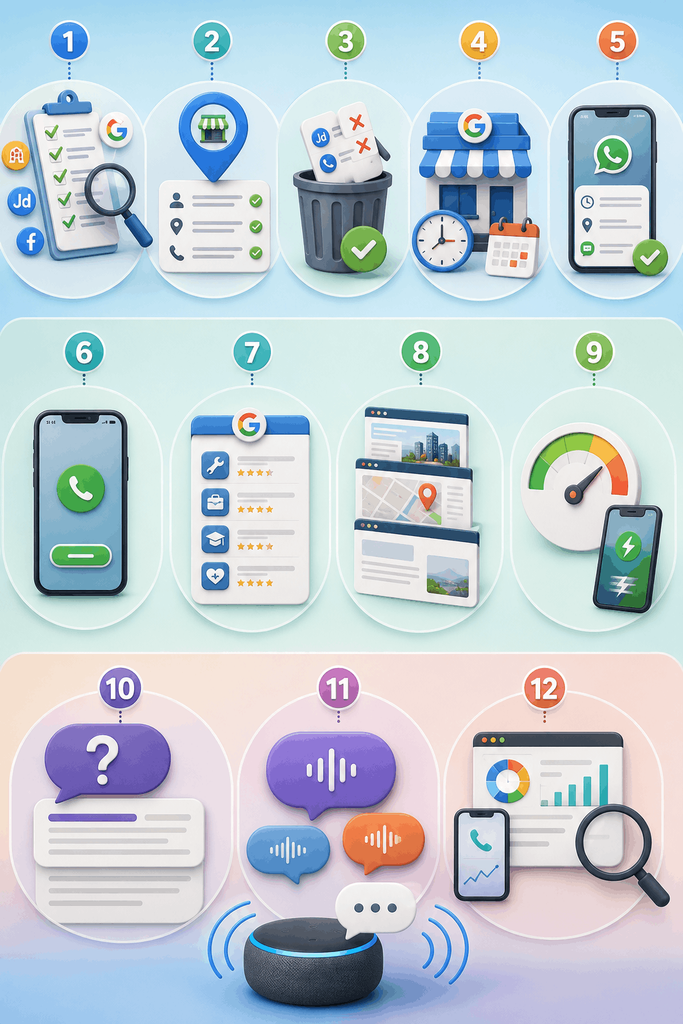
Work through them in order. Layer one is boring and it’s where the money is.
Layer 1 — Fix your facts (steps 1–5)
- Audit every place your business details appear, and write them down in one document. Website footer, Google Business Profile, Justdial, IndiaMART, Sulekha, your Facebook page, old franchise or association listings, that directory a vendor submitted you to in 2019. Most MSMEs find three to six conflicting versions of themselves.
- Pick one canonical format for your name, address and phone number, then make every listing match it exactly. “G-14, Malviya Nagar” and “Plot 14, Malviya Nagar Industrial Area” are two businesses as far as a machine is concerned. Same abbreviations, same order, same pincode, everywhere.
- Kill or correct every dead listing you find. An abandoned Justdial page with a landline you surrendered in 2021 is actively costing you calls. Claim it and update it, or get it removed.
- Set your Google Business Profile hours, including special hours for festivals. This is the single most expensive omission on this list. If your Diwali or Holi hours aren’t configured, the assistant tells a ready-to-buy caller you’re closed and moves to the next listing. There is no second result to click in a spoken answer.
- Fix your WhatsApp Business profile too. In India a voice search frequently ends in a WhatsApp message rather than a call. Set your business hours, address, category and an auto-reply there, and make sure your site’s click-to-chat link actually opens a chat on mobile.
Layer 2 — Make yourself reachable (steps 6–9)
- Make your phone number real, tappable text. Not inside an image, not injected by a widget that loads after four seconds. Use a tel: link in the header and on every service page.
- Add every service as its own entry on your Google Business Profile. Not one blob called “Consulting.” Separate entries for each thing a person might name aloud, because near me voice search resolves to the local pack, and the local pack matches on named services.
- Build one genuine page per service area you actually serve. Three to six real pages with local specifics, not forty thin pincode pages. Doorway pages get treated as spam, and I’ve watched sites lose rankings they already had by adding them.
- Get every page under three seconds on a mid-range Android over 4G. Test on a ₹12,000 phone on mobile data, not on office fibre and not on a desktop Lighthouse score. Voice queries happen in cars, in markets, on weak networks, and slow sources get skipped.
Layer 3 — Fix your phrasing (steps 10–12)
- Rewrite your key headings as spoken questions, and answer each in 40–60 words directly underneath. “Our Services” becomes “What does a GST consultant in Jaipur actually do?” followed by a complete, standalone answer, then the detail below it for humans who scroll. Read every heading aloud first — if you wouldn’t say it to a person, it won’t match what someone said.
- Work in the conversational keywords your buyers genuinely use, including Hinglish. Real spoken queries code-switch: “best CA Jaipur mein,” “AC repair wala near me,” “sabse sasta transport service.” Put those inside FAQ answers where they read naturally. Do not machine-translate your entire English site into Hindi — it reads wrong, matches spoken phrasing badly, and drags down pages that were already working.
- Track proxies, not “voice rankings.” Nothing separates voice from typed queries; Search Console doesn’t tag them and no tool reliably does. Filter GSC for question words and “near me,” watch calls and direction requests in GBP Insights, and once a month ask your own phone the ten questions your customers ask. That last test takes five minutes and tells you more than any dashboard.
Also Read This:- How AI Search Is Changing SEO
What actually goes wronga
People start at step 10. They rewrite content, publish an FAQ, and nothing moves, because their address still reads three different ways across the web. Content can’t fix a facts problem.
They register their GBP at a coworking desk. Shared and virtual addresses get flagged and suspended, and a suspended listing removes you from near me voice search entirely. If you don’t have a staffed address, run a service-area business instead.
They forget the answer is read aloud. A ninety-word sentence with two parentheticals is unlistenable. Short, plain, answer-first.
They treat it as a one-time project. A number changes, a branch moves, festival hours shift, and nobody updates anything. Voice punishes stale data harder than typed search does.
Optimize for Voice Search
Make your business easier to find through voice searches and AI-powered results.
Boost Your Voice Visibility No obligation. Straight talk only.Frequently Asked Questions
Is voice search optimization different from SEO?
No.Voice assistants read out results from the same index as typed search, so ranking factors are identical. What changes is emphasis: consistent business data across listings, complete local profiles, question-shaped headings with short extractable answers, and fast mobile pages.
Do Indian businesses need a smart speaker strategy?
No. The overwhelming majority of voice search in India happens on phones through the Google app and Assistant, not on Echo or Nest devices. Optimize for someone holding a phone in a noisy place on patchy mobile data.
Should I publish Hindi or regional-language content for voice search?
Only if your buyers speak that language when they contact you. If they do, write a small number of native question-and-answer pages rather than translating your whole site with a plugin. Google’s Search Live now supports ten Indian languages, so the demand is real, but poor translation costs more than none.
How do I measure results from voice search?
You can’t measure it directly, because no analytics tool isolates voice queries. Use proxies: growth in question-style and “near me” queries in Search Console, calls and direction requests in Google Business Profile Insights, and manual testing by asking your phone your customers’ questions each month.
How long before this shows results?
Listing and profile corrections often affect local visibility within days to a few weeks. Content restructuring on pages that already rank usually shows up in one to three months. On a brand-new site, expect standard SEO timelines.