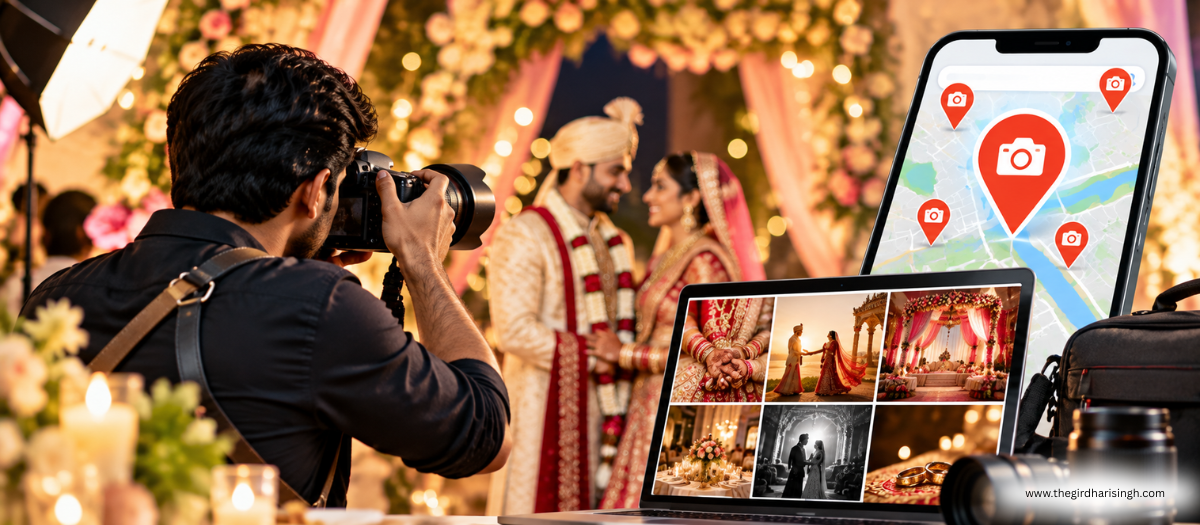
Your Google Business Profile photos are the product, not decoration. Set a service area instead of a street address, because you shoot across a region rather than from a shop. Then build a page for each venue you have actually worked at. “Wedding photographer at [venue name]” is a search almost nobody is targeting.
Photographers are the one local vertical where profile photos are the thing being sold. A plumber’s profile photo is a van. Yours is the sample. That changes what belongs there, and most photographers get it backwards.
Why do Business Profile photos matter more for photographers than any other business?
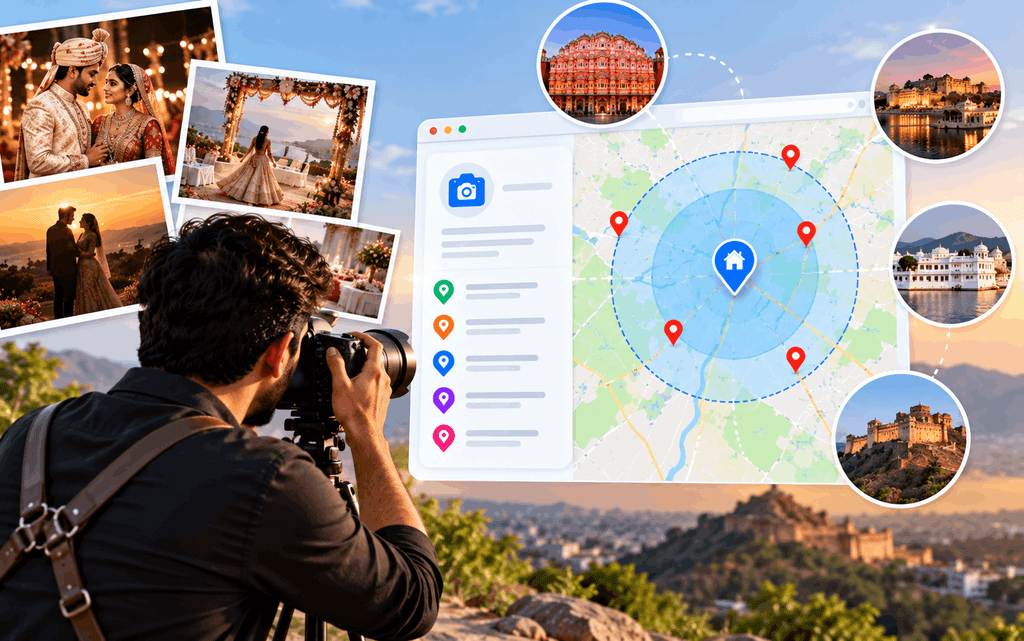
For you the photo is not evidence the business exists. It is the pitch.
That sounds like a reason to upload your strongest, most heavily graded frames. It is not, and this is where I lose arguments with photographers.
Google’s photo guidance is specific: the photo “should be in focus and well lit, and have no significant alterations or excessive use of filters. In other words, the image should represent reality” (Google Business Profile Help). Heavy grading is the house style of Indian wedding photography. Google asks for the opposite.
So here is the claim a competent competitor will argue with. Your strongest portfolio work should not be what you upload to your Business Profile. Put the honest, well-lit, minimally graded frames there — a real mandap in real light — and keep the cinematic grade for your website and Instagram.
The push-back is fair: photographers are judged on style, and a flat frame undersells you. I would rather be judged on style on the site they land on after the click than have profile images sitting outside Google’s guidance.
The technical requirements get broken without anyone noticing: JPG or PNG, 10 KB to 5 MB, 720 × 720 pixels recommended, 250 × 250 minimum. Uploads can take 24 to 48 hours to appear, and a 12 MB Lightroom export simply never shows up. More in my guide to Google Business Profile photos.
- Explore Now:- Local SEO for Real Estate Agents and Brokers in India
How should a photographer set up service areas instead of an address?
Hide the address and set service areas. You are not a walk-in business.
Google’s guidelines say a service-area business “should have one profile for the central office or location with a designated service area,” and “should hide your business address from customers” (Google Business Profile Help). Most photographers I look at have a home address visible on Maps — a privacy problem and a positioning one.
There is a boundary. Google states that “the boundaries of your profile’s overall service area shouldn’t extend farther than about 2 hours of driving time from where your business is based,” though larger areas may suit some businesses. Two hours from Jaipur covers a lot of wedding work. Not Udaipur, Delhi and Goa at once.
That matters more for you than almost anyone, because distance is one of the three factors Google names for local results, alongside relevance and prominence (Google Business Profile Help). You cannot move closer to the searcher. You can be honest about your real radius, so the profile competes where you can take the booking.
- Explore Now:- Local SEO for Lawyers and Law Firms in India
Do venue pages actually work, and how many should you build?
They work when you have actually shot there, and I would build three before thirty.
The mechanism is simple. People book a venue first and a photographer second. Once the venue is fixed, the search changes shape — from “wedding photographer in Jaipur” to the venue name plus what they need next. That search has a fraction of the competition.
A venue page earns its place only if it carries something you could not write without being there.
| Section of a venue page | What it must contain |
| Opening | The venue named, and that you shot there |
| Photographs from that venue | Your frames, not the venue’s press images |
| Light and timing notes | When the light works there, and when it does not |
| Logistics learned on site | Access, permissions, power, drone rules |
| What coverage costs there | A range, based on how these events run |
| A clear next step | Enquiry form, venue prefilled |
Without the light notes and the logistics you have a thin page with a venue name on it — the same trap that catches location pages. I covered that in the guide to building locality pages without thin content, and the rules carry across unchanged.
How do you do image SEO on a portfolio without killing page speed?
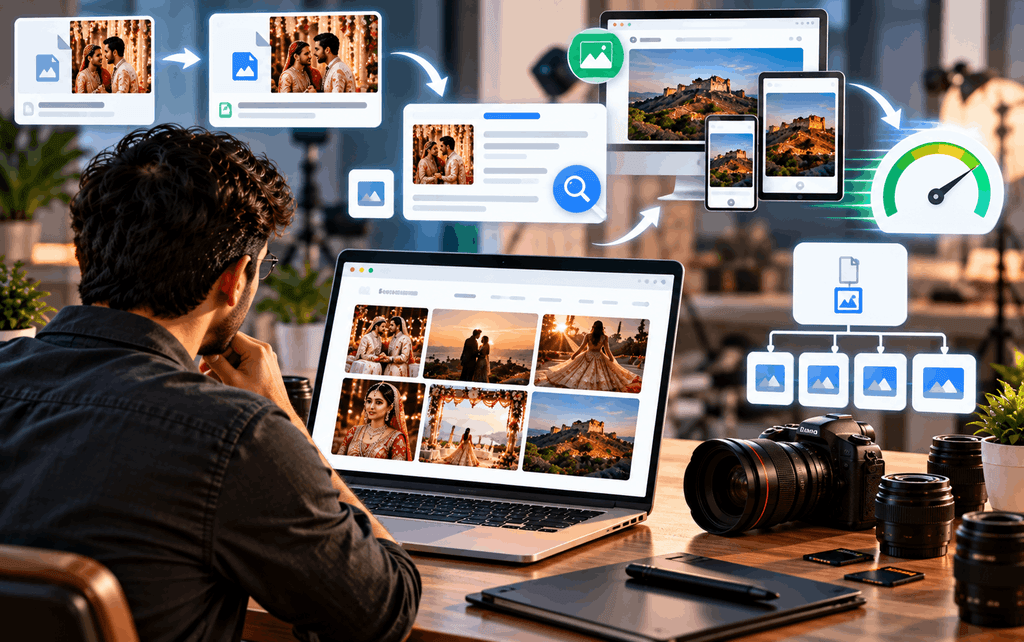
Filenames that describe the image. Google asks for filenames that are “short, but descriptive” (Google Search Central). A camera export named DSC_4471 tells a crawler nothing. Rename before upload — a batch operation, not a per-file chore.
Alt text written like a sentence. Google calls alt text “the most important attribute” for image metadata and warns against stuffing it with keywords. Describe the frame the way you would to someone who cannot see it.
Images placed near text that explains them. Google’s guidance is to put images “near relevant text and on pages that are relevant to the image subject matter.” A gallery grid with no words around it gives a crawler no context — the biggest weakness of the standard portfolio layout.
Responsive images with a fallback. Use the srcset attribute or the picture element, and keep an ordinary src fallback, because as Google notes, “some browsers and crawlers don’t understand these attributes.”
One more that people miss: if your images sit on a CDN or a separate gallery host, an image sitemap lets you give Google “the URL of images we might not have otherwise discovered”, including images on another domain. If your portfolio images live on Pixieset or a similar platform, an image sitemap is the most reliable way to get them found. (Private client-proofing galleries should stay out of search anyway.)
I changed my mind about one thing. I used to tell photographers to move everything onto their own domain. Now I accept that client galleries belong on a delivery platform. The real question is which frames live on your site as portfolio work — those need to be yours, indexed, and surrounded by text.
- Explore Now:- Local SEO for Gyms and Fitness Studios in India
What breaks in practice for photographers?
The enquiry goes to a number nobody answers on a shoot day. You are unavailable for eight hours at a stretch. Either someone else answers, or the profile needs a booking link rather than a phone-first CTA.
Portfolio pages that rank for nothing. Beautiful, wordless, twelve images and a name. Nothing for a search engine to match a query against.
The same forty images on every page. Duplicate galleries on the city page, the venue page and the home page give Google no reason to treat any of them as distinct.
Uploads that silently fail. Over 5 MB, or a format that is not JPG or PNG. Nothing tells you; the photo just never appears.
A service area drawn around ambition, not practice. Every district in the state listed, when three accounted for every booking last year.
When is local SEO the wrong priority for a photographer?
Three situations where I would spend the effort elsewhere.
You shoot destination weddings only. If the couple is in Mumbai, the wedding is in Udaipur and you fly to both, local search is not where they find you. Planner relationships are.
Bookings come entirely through Instagram and referrals, and you are full. Local SEO adds a channel. If the existing one fills your calendar, another mostly adds admin.
You are a product or commercial photographer serving brands nationally. Your buyers search by capability, not locality. A service-area profile does little for you.
This work is also slower than photographers expect. Google publishes no ranking timeline, and a venue page must be crawled, indexed and then compete before it does anything. If you need bookings this month, this is not the lever — ongoing local SEO work is a programme, not a quick fix.
Where should you start in the next ten minutes?
Open your Google Business Profile on a phone and look at the first three photos a stranger sees.
Ask two things. Are they in focus, well lit and free of heavy grading, as Google’s guidance asks? And do they show the work you want booked? If the first three are a logo, a blurred venue shot and a group photo from 2022, that is your afternoon sorted.
Ten minutes, and it tells you whether the problem is the profile or the portfolio.
If you want the service area, the photo set and the venue pages planned together, that is what my local SEO work with service-area businesses covers — get in touch with your studio name and the areas you shoot in.
Want More Photography Clients?
Boost your local visibility and attract more clients with SEO.
Grow Your Photography Business. No obligation. Contact us today.Frequently asked questions
Should a photographer hide their address on Google Business Profile?
Yes, if you work at client locations rather than a studio people visit. Google’s guidelines say service-area businesses should hide the address and set a designated service area instead. If clients come to your studio, keep the address visible. If you do both — studio visits and on-location shoots — keep the address and add service areas as well.
How many photos should I upload to my Business Profile?
Google does not publish a number. What matters is that the first few represent the work you want booked, that they meet the technical requirements, and that new ones keep arriving. Twelve current, honest frames beat eighty uploaded two years ago and never touched.
Do venue pages count as duplicate content?
Not if each carries something specific to that venue — your own photographs taken there, notes on the light, access and permissions, and a realistic cost range. Pages differing only by venue name are thin, and that is the risk. Three genuine venue pages beat thirty templated ones.
Will Instagram help my Google ranking?
Not directly. Google names relevance, distance and prominence as the factors behind local results, with prominence influenced partly by links and reviews. An Instagram profile can link to your site and push people to search your name, which helps indirectly. Treat it as a booking channel, not an SEO tactic.
What image format should I use for portfolio pages?
For your Business Profile, JPG or PNG between 10 KB and 5 MB, at least 250 × 250 pixels and ideally 720 × 720. On your own site you have more freedom, and modern formats such as WebP or AVIF load faster. Whatever you pick, keep a descriptive filename, real alt text, and words nearby.