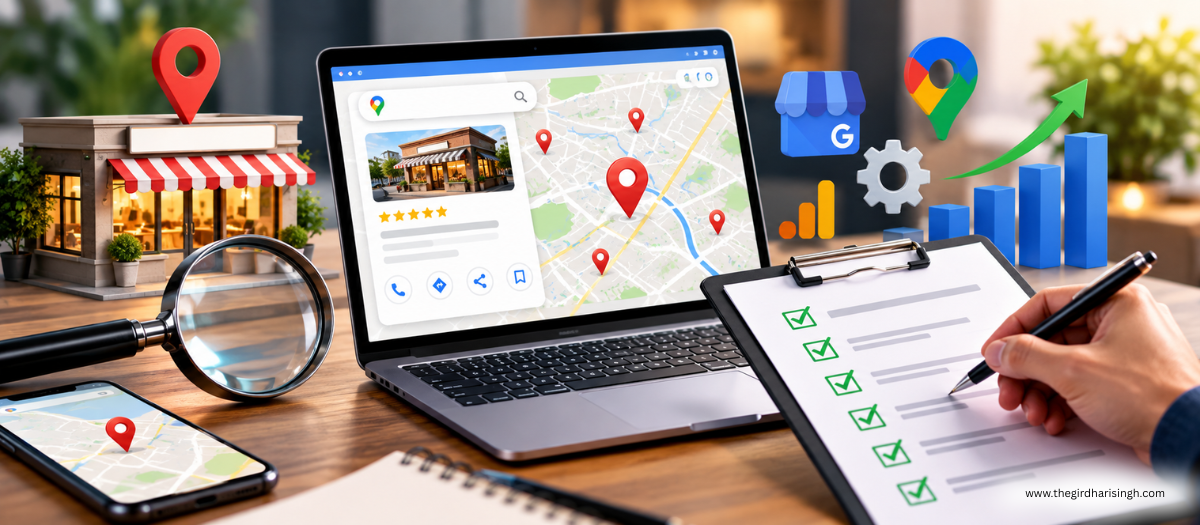
Run all 40 checks and score each out of 3: 0 is absent, 1 is present but wrong, 2 is done but not maintained, 3 is done and maintained. Total out of 120. In my experience the gap between you and the business outranking you is almost never forty half-done things. It is one check at zero.
That is why I stopped handing clients audits that come back as forty amber items. A list of forty problems gives no order of operations, so people start at the top and work down. A score does what a pass-or-fail list cannot: it names the one thing to do on Monday morning.
Why score each check out of 3 instead of pass or fail?

Because pass or fail hides the difference between “not done” and “done badly”, which need opposite fixes.
A profile with no service area set and one covering half of Rajasthan both fail a binary check. One needs a first entry, the other a correction. Score them 0 and 1 and the distinction survives.
The scale also forces the maintenance question. Plenty of businesses score 2 across the board — filled in once at launch by someone since departed. Hours stale, photos three years old, category fitted the business of 2022. A 2 looks healthy and behaves like a 1.
Here is the claim a competent SEO will argue with. Fix your single lowest score before touching anything already scoring 2. The standard advice is quick wins for momentum. I think that is backwards for local: Google names relevance, distance and prominence as the three factors, and a zero usually means one is not being read at all. Topping a 2 up to a 3 while a 0 sits there moves nothing.
If your zero is trivial — a missing attribute, say — you should disagree. The rule holds for zeros sitting on the three factors, not every zero on the sheet.
- Explore Now:- Local SEO for Real Estate Agents and Brokers in India
What are the 40 checks?
Five groups of eight. Score each out of 3 as you go. This is the whole audit — screenshot it and work down it.
Group A — Profile foundations
| # | Check | A 3 looks like |
|---|---|---|
| 1 | Profile claimed and verified | Verified, login in your hands |
| 2 | Name matches the real-world name | Exactly what is on the storefront |
| 3 | No keywords stuffed in the name | No city, service or tagline |
| 4 | Address complete and correct | What the post office would accept |
| 5 | Address hidden if service-area only | Hidden, service areas set instead |
| 6 | Primary phone is real and answered | Rings a person during stated hours |
| 7 | Website URL points somewhere relevant | A service page if one fits better |
| 8 | Duplicates found and removed | One profile per real location |
Group B — Categories, services and coverage
| # | Check | A 3 looks like |
|---|---|---|
| 9 | Primary category is right | The most specific one available |
| 10 | Secondary categories kept minimal | Genuine lines of business only |
| 11 | No category added for keyword reach | Each one defensible to a customer |
| 12 | Services list filled in | Named the way customers name them |
| 13 | Service descriptions written | Each one a real sentence |
| 14 | Service area matches where you go | Within two hours’ drive of base |
| 15 | Products or menu added if allowed | Current and priced |
| 16 | Attributes set honestly | Parking, access, payment methods |
Group C — Hours, posts and photos
| # | Check | A 3 looks like |
|---|---|---|
| 17 | Regular hours correct today | Survives a customer turning up |
| 18 | Festival and special hours set ahead | Diwali, Holi and local closures in |
| 19 | Hours match site and phone greeting | All three agree |
| 20 | Exterior photo that finds the door | Recognisable from the street |
| 21 | Interior photos of the real place | Not stock imagery |
| 22 | Team or work-in-progress photos | Real people, real jobs |
| 23 | Photos added recently | Something in the last 90 days |
| 24 | Posts or updates kept current | Something posted this month |
Group D — Reviews and responses
| # | Check | A 3 looks like |
|---|---|---|
| 25 | Reviews arrive steadily | A trickle, not bursts |
| 26 | No incentivised or paid reviews | Nothing offered in exchange |
| 27 | Nobody asked to review on site | Requests go out after the job |
| 28 | Every review answered | Including the bad ones |
| 29 | Responses answer the point | Specific, not templated |
| 30 | Negative reviews handled calmly | Factual, and offers a fix |
| 31 | Review requests are a routine | Built into your handover |
| 32 | Other platforms not ignored | Wherever your customers look |
Group E — Website and consistency
| # | Check | A 3 looks like |
|---|---|---|
| 33 | Site details match the profile | Character for character |
| 34 | Contact details are real text | Selectable, not an image |
| 35 | A page per core service | Not one page listing everything |
| 36 | Local business markup present | Name and address at minimum |
| 37 | Markup agrees with the page | Nothing marked up that is hidden |
| 38 | Site works on a mid-range phone | Tested on a real Android device |
| 39 | Directory listings agree | Same name, address and phone |
| 40 | Old details chased down | Nothing stale left live |
A downloadable sheet with a scoring column sits behind an email form. The tables stay ungated — a checklist that only exists as a download is one nobody screenshots.
How do you score it, and what does the total mean?
Add the forty scores, out of 120. Read it like this.
- Any single 0 in Groups A, B or D. Fix it first, whatever your total. Those groups map most directly onto how Google describes local results working.
- Under 60. The profile itself is the problem. Little on the website side helps until this is fixed, and it is usually two weekends of work.
- 60 to 95. The basics exist but nothing is maintained. Where most Indian MSMEs I audit land; the fix is a monthly routine, not a project.
- 96 and above. You are competing on prominence now — reviews, links, reputation. Another audit will not move you. This is where ongoing local SEO work earns its fee and a checklist stops.
The scale is mine, not Google’s. A way of ordering work, not a measurement of anything Google publishes.
Which zeros actually cost you rankings?
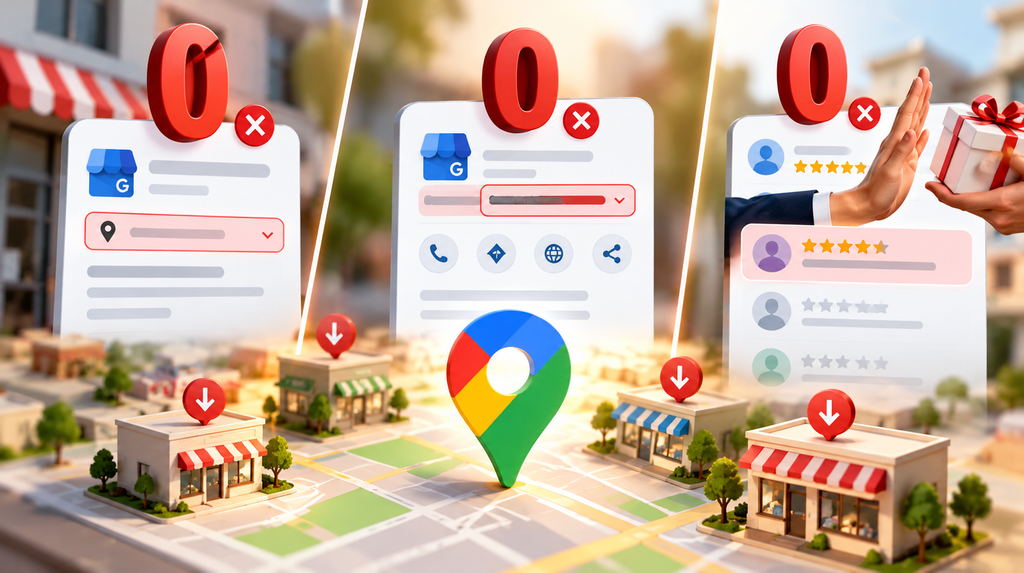
Google states that local results are based primarily on relevance — “how well a Business Profile matches what someone is searching for” — distance, and prominence, “how well-known a business is” (Google Business Profile Help). Three checks map straight onto those.
Check 9, the primary category. The strongest relevance signal you control. Google’s guidelines ask you to “use as few categories as possible to describe your overall core business” and to pick categories completing “this business is a” rather than “this business has a” (Google Business Profile Help). A wrong one caps everything above it.
Check 3, keywords in the business name. Google’s guidelines say your name “should reflect your business’s real-world name, as used consistently on your storefront, website, stationery,” and bar marketing taglines, location and service information. Adding your city and service is not a grey area. It is the most common suspension risk I see on Indian profiles.
Check 26, incentivised reviews. Google’s review policy prohibits “content that has been posted due to an incentive offered by a business — such as payment, discounts, free goods and/or services.” Reviews are prominence. Buying them risks the whole profile.
What breaks in practice?
It gets run once and filed. A score is a snapshot. The businesses that gain re-score quarterly, watching the 2s that slid to 1.
Someone scores generously. Audit your own profile and you score a 2 where an outsider scores 1. Have someone else run it, or score strictly.
The name gets “optimised” anyway. Someone reads that keywords in the name correlate with rankings and adds them. It may work for a while. Google states plainly that “there’s no way to request or pay for a better local ranking,” and suspension costs more than the lift.
Duplicate profiles nobody knew about. An old listing made by a former employee, or auto-generated years ago. They split your signals and stay invisible until you search your address.
- Explore Now:- Local SEO for Gyms and Fitness Studios in India
When is this audit the wrong thing to run?
You have no Google Business Profile at all. Create and verify one first. The audit assumes something to audit.
You are pure e-commerce or national, with no premises or service area. Local results are not your channel; product pages are.
You scored above 96 last quarter. Running it again tells you what you know. Your constraint is prominence, earned off the profile.
I changed my mind about one thing. I used to run the website checks first, because that is where an SEO feels useful. Now I run Groups A to D before touching the site. On most Indian MSME profiles the profile-side zeros are bigger than anything I could fix on the site in the same time. Same ordering logic as the AI search visibility audit, where this scorecard format came from.
Where should you start in the next ten minutes?
Search your business name plus your city on a phone you are not signed into, and look at what comes back.
Check three things: is the name exactly your real-world name, is the primary category what you would have chosen, and does the phone match what you answer. That is checks 2, 9 and 6 — three of the four zeros I find most often.
Ten minutes, and it usually tells you whether you have a profile problem or a competition problem.
If you would rather someone scored it properly and named the zero to fix first, that is where my local SEO work with Indian businesses starts — get in touch with your business name and city and I will tell you what I can see from outside.
Want Better Local SEO Results?
Find SEO issues and improve your local visibility.
Start Your Local SEO Audit. No obligation. Contact us today.Frequently asked questions
How long does a local SEO audit take to run?
An afternoon for forty checks, given access to the Google Business Profile and the website. Most of that goes on Groups A and B, comparing what is on the profile against what is true. Scoring is fast. Deciding what your lowest score means takes longer.
Do I need paid tools to run this audit?
No. All forty run on the Google Business Profile dashboard, your own website, and a phone you are not signed into. Paid tools help with directory listings and rank tracking at scale, but nothing here needs one. Start free and buy tools once you know what you are missing.
Will fixing my checklist score guarantee better rankings?
No. Google states there is no way to request or pay for a better local ranking, and publishes no formula. The checklist removes reasons not to rank rather than buying rank. If you score 120 and still lose, your constraint is prominence or distance, and neither is fixed by a checklist.
Should I remove keywords from my business name if they are already working?
Yes, in my view. Google’s guidelines bar location, service and tagline information in the name, so the listing is non-compliant however well it performs. A suspension removes you entirely, which costs more than the ranking you give up by correcting it.
How often should I re-run this audit?
Quarterly for most businesses, monthly if hours, staff or services change often. The scores that decay fastest are hours, photos and reviews — Groups C and D — because they need someone doing something regularly. Groups A and B rarely change once correct.